
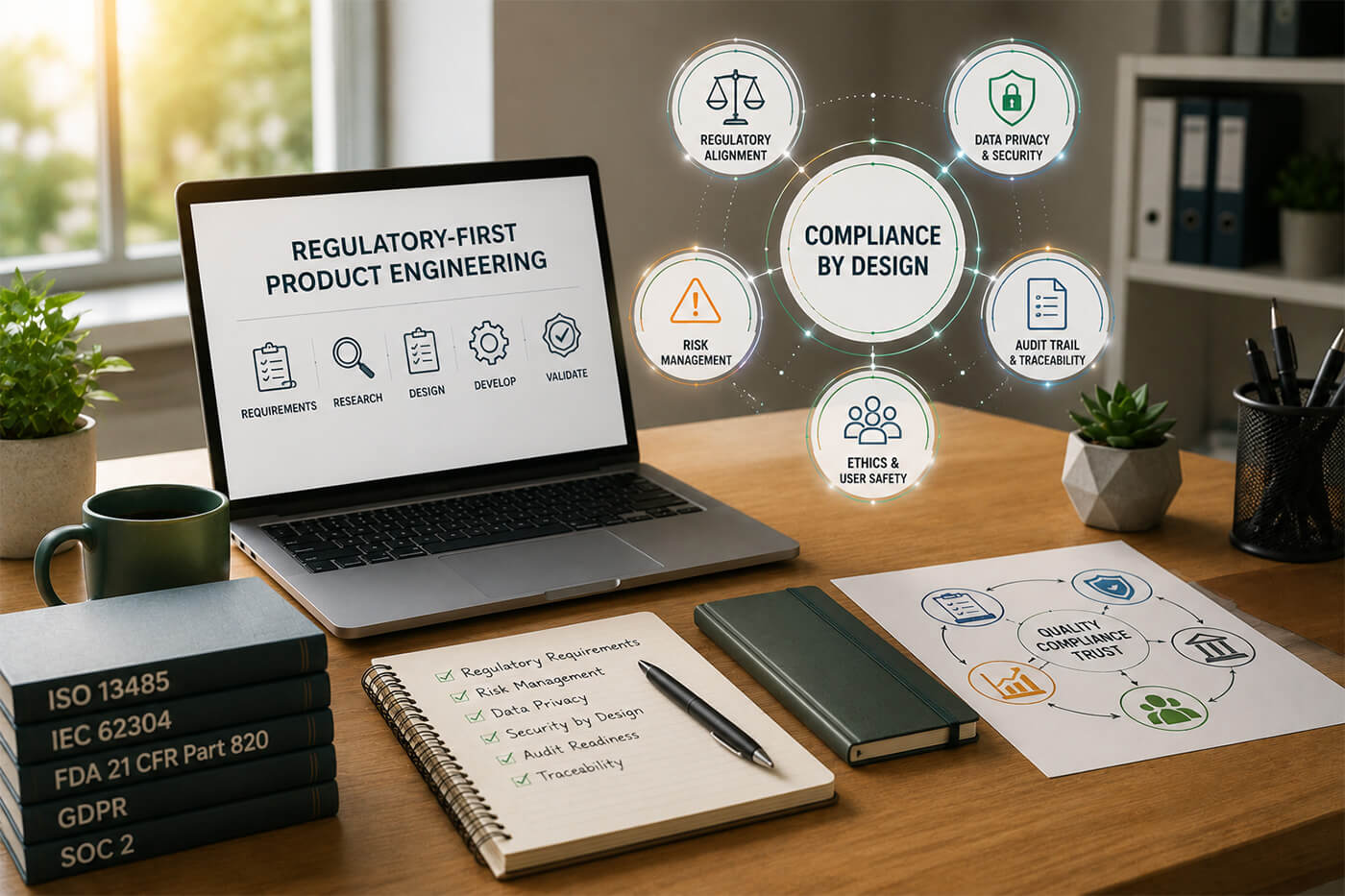
Regulatory-first product engineering is rarely planned upfront, yet it determines how long a digital product can survive in regulated markets.
Regulation has fundamentally changed how digital products are built. It is no longer a late-stage checkbox or a legal formality. Instead, it has become a core design constraint that shapes architecture decisions from day one.
Across fintech, healthcare, SaaS, and enterprise platforms, regulatory requirements influence every layer of a product. They affect data flows, decision logic, auditability, and even release velocity. As organizations expand globally, these challenges only intensify.
At Netwin, this shift is visible across product engineering initiatives for regulated industries. Teams are no longer asking how to “add compliance later.” They are asking how to build products that remain compliant as regulations evolve.
This reality has given rise to regulatory-first product engineering. It is not a framework or a toolset. It is a mindset that treats regulation as a design input, not a delivery obstacle.
Understanding Regulatory-First Product Engineering in Modern Software
Regulatory-first product engineering begins with a simple idea. Compliance should be engineered into the product, not layered on afterward. In traditional product development, regulation is often addressed during testing or deployment. This approach worked when regulatory changes were infrequent. However, it fails in today’s environment of constant policy updates and regional variation.
A regulatory-first approach flips this sequence. It ensures systems are designed for traceability, accountability, and adaptability from the beginning. This reduces long-term risk while improving product resilience. At Netwin, regulatory-first thinking often starts at the architecture stage. Design decisions are made with audits, investigations, and future regulatory shifts in mind.
As a result, products remain flexible without becoming fragile.
Why Regulatory-First Product Engineering Is Now a Core Requirement?
Regulation has increased in both volume and complexity. Organizations must now comply with overlapping regional, national, and industry-specific rules.
For example, a single product may need to satisfy multiple data protection laws. It may also need to adapt decision logic for different markets. These changes rarely happen once. They happen continuously.
As a result, product engineering teams face growing pressure. They must move quickly while maintaining strict compliance. This tension exposes the limitations of traditional engineering models. Regulatory-first product engineering addresses this challenge directly. It accepts regulation as a permanent condition. Then, it designs systems that can thrive under that condition.
The Structural Risk of Hardcoding Rules:

One of the biggest barriers to regulatory-first product engineering is hardcoded logic.
Hardcoding regulatory rules inside application code may seem efficient initially. It allows teams to move fast during early development. However, this speed is deceptive.
Over time, every regulatory update becomes a code change. Each change introduces risk, delays, and dependency on engineering availability. Small updates can trigger large regressions.
From our experience in modernizing legacy platforms, this pattern is common. Hardcoded rules create brittle systems that resist change. They also make audits difficult and explanations unreliable.
Therefore, eliminating hardcoded regulatory logic is a foundational step. It creates space for adaptability without sacrificing control.
Separating Rules, Policies, and Decisions:
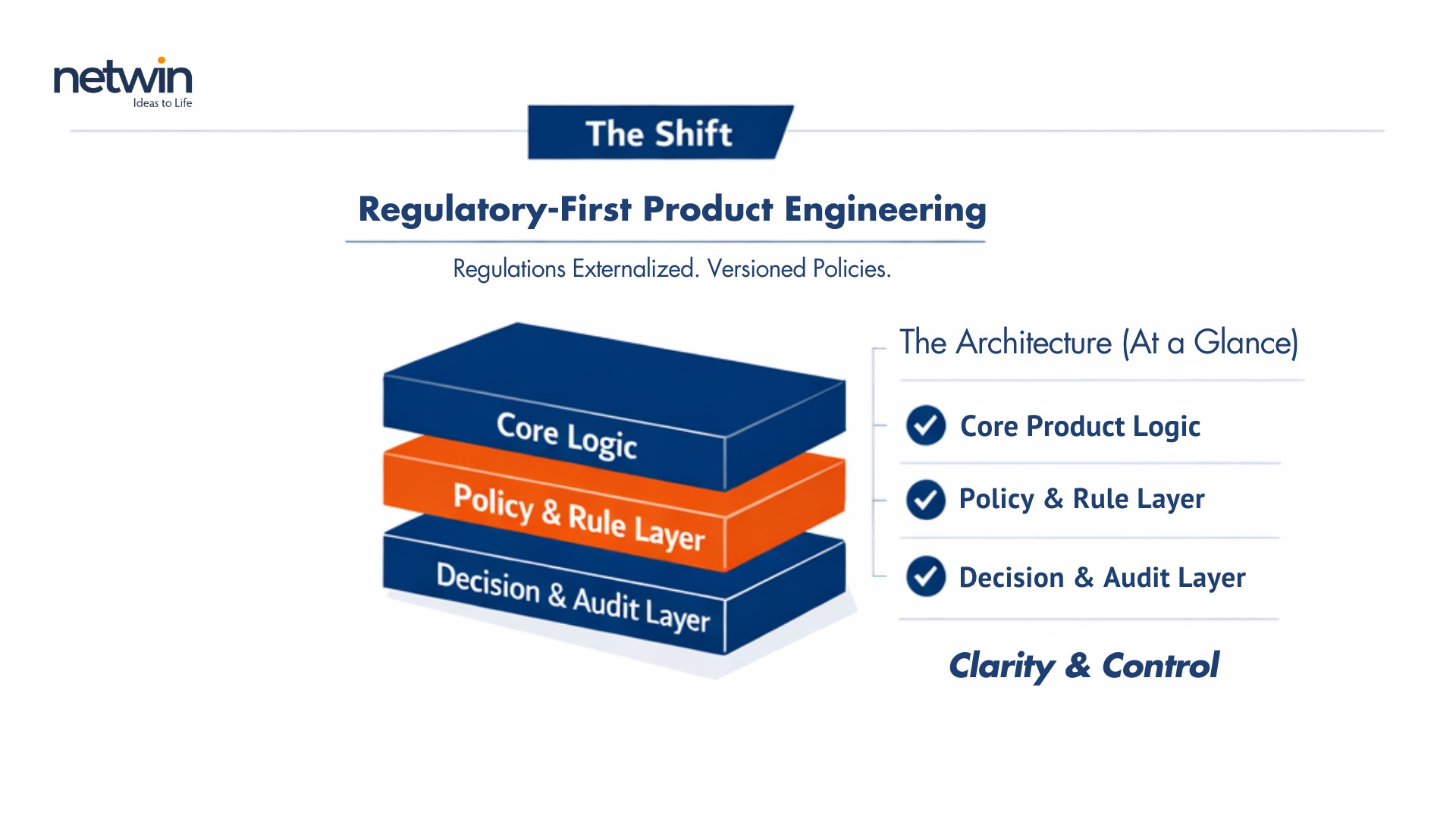
Clarity is essential in regulated systems. This clarity comes from separation. In regulatory-first product engineering, rules, policies, and decisions serve different purposes.
- Rules define how the system operates.
- Policies define what is allowed or restricted by regulation.
- Decisions represent outcomes based on rules and policies.
Separating these elements improves system transparency. It also reduces coupling between compliance and core functionality. This separation makes systems easier to reason about.
At Netwin, this approach consistently improves collaboration. Engineering teams focus on stability and performance. Compliance teams gain visibility into how policies are applied. As a result, changes become safer and more predictable.
Why Separation Improves Speed and Governance?
Separation is not only about clarity. It directly improves speed and governance. When policies change, teams can update configurations instead of code. When decisions evolve, core systems remain untouched. This significantly reduces deployment risk.
Governance also improves naturally. Rules and policies become explicit and reviewable. Audit conversations shift from reconstruction to verification. In a regulatory-first world, this capability is critical. Speed without governance creates risk. Governance without speed creates stagnation. Separation enables both.
Versioned Logic and the Importance of Traceability
Traceability is a non-negotiable requirement in regulated environments. Regulators do not only care about what happened. They care about why it happened. Versioned logic enables this level of accountability. It allows teams to track which rules and policies were active at any point in time. This includes historical decisions and automated outcomes.
Without versioning, audits become investigative exercises. Teams rely on memory, logs, and assumptions. This creates unnecessary stress and exposure. At Netwin, traceability is designed as a core product capability. Versioned logic is treated as a feature, not documentation. This approach simplifies audits and strengthens trust.
Use Case: Regulatory-First Product Engineering in a Global Fintech Platform
Consider a fintech platform offering digital lending services across multiple regions. The core product handles customer onboarding, credit decisions, and transaction processing. Each of these functions is subject to different regulatory requirements.
In one region, lending decisions must follow strict transparency rules. In another, data retention policies are more restrictive. Regulatory updates also arrive frequently, often with short implementation timelines.
The Traditional Approach and Its Challenges
Initially, the platform embedded regulatory logic directly into application code. Each regional variation required conditional logic and feature flags. Over time, the codebase became difficult to manage.
When regulations changed, releases slowed down. Engineering teams had to re-test unrelated features. Audit requests required manual reconstruction of historical decisions. This approach increased operational risk and compliance overhead. Scaling into new regions became expensive and unpredictable.
Applying Regulatory-First Product Engineering
The platform adopted a regulatory-first product engineering approach. Rules, policies, and decisions were separated into distinct layers. Regulatory constraints were externalized from the core application.
Versioned policies were introduced for each region. This allowed the team to track which rules applied at any point in time. Auditability improved without adding engineering burden.
At Netwin, similar architectural shifts are often implemented during platform modernization. The focus remains on clarity, traceability, and scalability.
The Outcome
- Regulatory updates no longer required core code changes.
- New regions could be onboarded through policy configuration.
- Audit responses became faster and more reliable.
- Most importantly, the platform regained release velocity.
- Compliance stopped being a blocker and became a built-in capability.
This is the practical value of regulatory-first product engineering. It enables growth without increasing complexity.
Accountability as an Engineered Outcome
Accountability cannot be retrofitted. It must be engineered. Versioned logic ensures accountability across time, regions, and users. It provides clarity during disputes, investigations, and compliance reviews. This capability becomes especially valuable in global products.
Regulatory-first product engineering recognizes accountability as a product outcome. Not a compliance artifact. When accountability is built in, confidence increases across stakeholders. This includes regulators, customers, and internal teams.
Scaling Digital Products with Regulatory-First Product Engineering
Global expansion introduces regulatory diversity. Each market brings unique compliance requirements. Many organizations respond by duplicating applications. They create separate systems for each region. This approach increases cost and complexity.
Over time, these systems diverge. Maintaining consistency becomes difficult. Innovation slows down. At Netwin, scalability is approached differently. One core application is maintained. Regulatory variation is handled through rule and policy versions. This allows organizations to scale globally without scaling engineering debt.
Designing for Regional Flexibility
Regional flexibility must be intentional. It cannot be improvised. Regulatory-first product engineering treats geography as a configuration challenge. Not a code duplication problem. Rules and policies adapt while the core system remains stable.
This approach reduces maintenance overhead. It also accelerates market entry. New regions no longer require rebuilding core functionality. As regulations continue to fragment globally, this capability becomes essential.
Core Principles Behind Regulatory-First Product Engineering
Several principles consistently guide regulatory-first systems. First, modular architecture is critical. Systems must be loosely coupled and independently evolvable.
Second, configurability matters. Rules and policies should be managed externally. This reduces dependency on engineering teams.
Third, governance must be embedded. Auditability and traceability should exist by design. At Netwin, these principles guide product engineering across regulated domains. They ensure systems remain adaptable without becoming unstable.
Improving Collaboration Between Engineering and Compliance
Regulatory-first product engineering improves team alignment. Compliance teams gain visibility into system behavior. Engineering teams gain clarity on regulatory expectations. Business teams gain confidence in scalability.
This alignment reduces friction and miscommunication. Compliance becomes proactive rather than reactive. Engineering becomes more predictable. As a result, organizations move faster with less risk.
The Business Impact of Regulatory-First Engineering
The business benefits are substantial. Time-to-market improves because regulatory changes no longer block releases. Compliance risk decreases because systems are designed for adaptability. Customer trust increases through transparency and accountability.
Organizations working with Netwin often experience these outcomes. They build products that scale across regions without fragmentation. They also reduce long-term operational costs. In regulated industries, this becomes a strategic advantage.
Regulation as a Design Constraint, Not a Limitation
Regulation is often viewed as a blocker. However, this perspective limits product quality. When treated as a design constraint, regulation enforces discipline. It encourages clarity, traceability, and resilience. These qualities improve systems overall. Regulatory-first product engineering embraces this reality. It designs for the world as it exists today.
At Netwin, this philosophy shapes how future-ready digital products are built.
Final Thoughts
Regulation will continue to evolve. Complexity will increase across industries and regions. Reactive approaches are no longer sufficient. Product teams must design for change. Regulatory-first product engineering offers a sustainable path forward. It balances speed, compliance, and scalability. It produces systems that last.
Products built this way are not just compliant. They are resilient, explainable, and future-ready. And increasingly, that is what the modern digital world demands.