

Software architecture decisions made in the early stages of product development rarely feel permanent. Teams are focused on delivering an MVP, validating product-market fit, and releasing features quickly. Trade-offs feel acceptable. Constraints feel temporary. The architecture seems flexible enough to evolve later.
But as the product grows across users, data, integrations, and geographies, those same early architecture decisions quietly transform into structural limitations.
- What once enabled speed begins to restrict scale.
- What once simplified delivery begins to complicate change.
- What once supported launch begins to block expansion.
This is one of the most persistent yet underestimated realities in software product engineering.
The Hidden Cost of Early Architecture Decisions
Architecture is often framed as a technical foundation. In practice, it is a business trajectory decision. When products are young, architecture is shaped by immediacy. Teams operate under pressure to launch quickly with limited resources and evolving requirements.
Under these conditions, optimizing for short-term delivery is rational. Decisions that reduce development effort or accelerate release are prioritized, while extensibility and long-term scalability feel like future concerns.
The difficulty emerges because architecture decisions do not remain localized. They propagate into code structures, data models, workflows, integration patterns, and deployment strategies. Over time, these decisions become embedded across the product’s entire ecosystem.
Unlike features or interfaces, architecture cannot be redesigned incrementally without systemic impact. Once a product reaches scale, changing architecture is no longer a refactor, it becomes transformation.
This distinction explains why architectural debt is more consequential than code debt. Code debt slows engineering teams. Architectural debt constrains business evolution.
Why Software Architecture Decisions Become Hard to Change
As software products mature, architecture accumulates inertia. What began as a flexible structure gradually becomes rigid due to its entanglement with surrounding systems and organizational realities.
Early structural choices shape domain boundaries, service interactions, and data relationships. As development continues, thousands of implementation decisions assume these structures. APIs depend on them, integrations rely on them, and workflows embed them. Changing architecture eventually requires revisiting assumptions across the entire system landscape.
Growth amplifies this rigidity. Mature products rarely operate in isolation; they connect to partner ecosystems, enterprise platforms, analytics pipelines, and multiple client applications. Each connection reinforces the existing architectural shape. Altering the core structure begins to affect not only internal components but external dependencies.
Data further complicates change. A mature product holds years of historical records, active transactions, and regulatory obligations. Migrating architecture now involves transforming live data at scale while maintaining operational continuity. The technical complexity increases, but so does organizational risk perception. Revenue-generating systems become difficult to alter because disruption carries financial and reputational consequences.
Over time, architecture becomes stable not because it is optimal, but because change feels dangerous. Organizations adapt around its limitations instead of replacing it. This is how temporary decisions become permanent constraints.
Common Software Architecture Decisions That Create Future Problems
Many architecture challenges originate from decisions that were entirely reasonable at the time they were made. The problem is not poor judgment but context mismatch: choices optimized for early-stage speed become misaligned with later-stage scale.
Software Architecture Decisions That Prioritize Speed Over Scalability
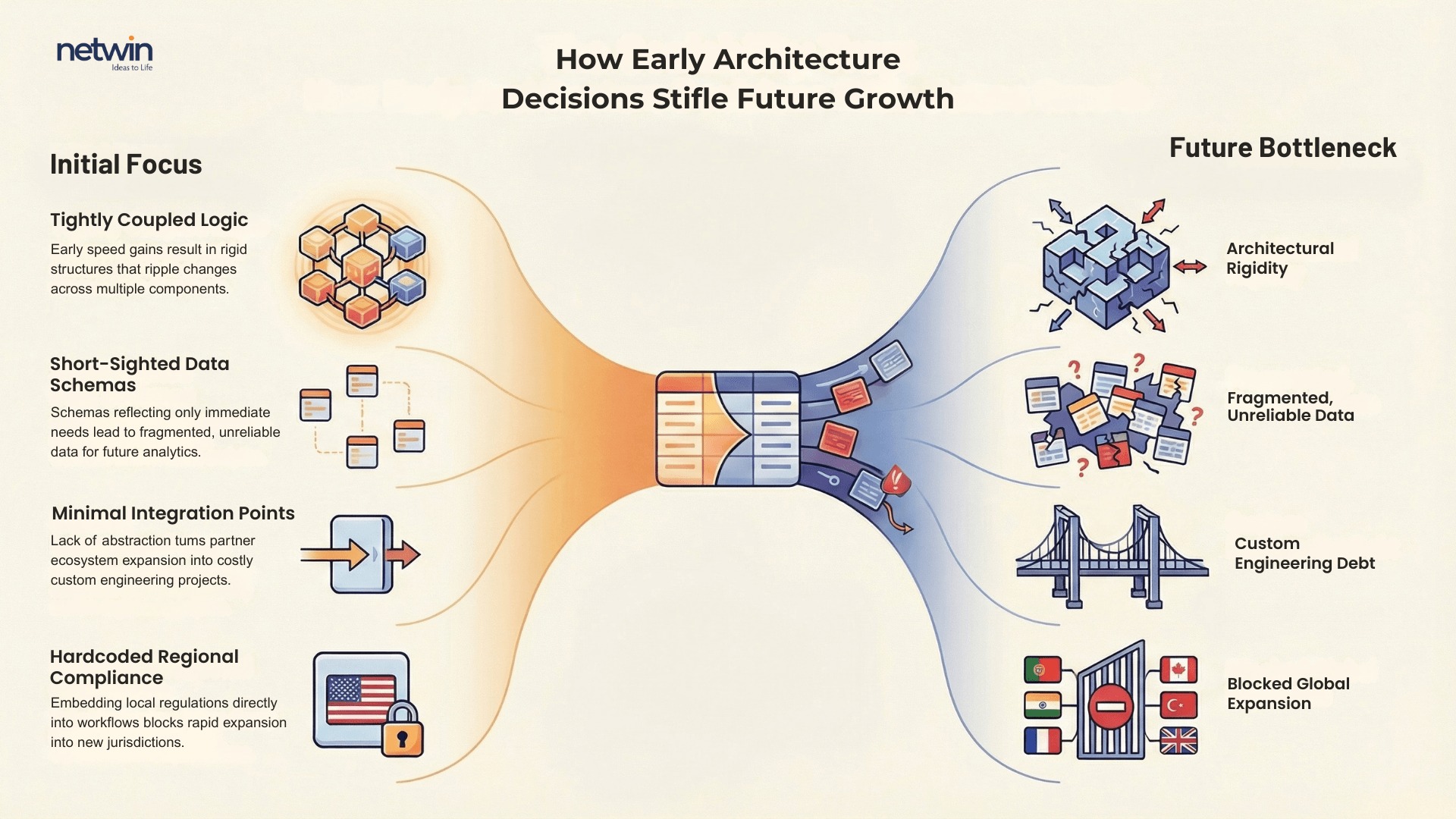
One recurring pattern is optimizing for delivery velocity through tightly coupled structures. Early products often centralize logic and embed workflows directly into code to accelerate development. This simplifies implementation but reduces modularity. As features accumulate, the architecture becomes rigid. Changes that should affect one domain begin to ripple across multiple components, slowing evolution.
Ignoring Integration and Interoperability
Early-stage products frequently assume a controlled environment with limited external interaction. As a result, APIs remain minimal, abstraction layers thin, and extension points absent. When ecosystem integration becomes necessary through partners, enterprise clients, or marketplaces, the architecture lacks stable boundaries. Integration turns into custom engineering rather than configuration.
Underestimating Data Architecture
Initial schemas often reflect immediate transactional needs without anticipating analytics, governance, or multi-domain use. Over time, duplicated entities, inconsistent definitions, and fragmented ownership create silos. As organizations seek insights or regulatory transparency, these structural weaknesses surface. Data becomes abundant but unreliable.
Compliance as an Afterthought
Products launched in a single region embed local regulatory assumptions directly into workflows and data structures. When expansion into new jurisdictions begins, differences in consent models, reporting requirements, and audit expectations emerge. Because compliance logic is hardcoded rather than abstracted, adaptation requires architectural change instead of configuration. Expansion slows, not because the product lacks demand, but because its structure lacks adaptability.
How Software Architecture Decisions Multiply Technical Debt
Technical debt is often discussed at the level of code quality. In software product engineering, however, the most consequential debt is architectural. Its impact expands with scale.
As products grow in users, features, integrations, and geographic reach, architectural limitations multiply friction across the system. Performance tuning becomes harder because structural inefficiencies are systemic. Feature delivery slows because modules are tightly interdependent. Integrations become fragile because interfaces were not designed for extension. Compliance adjustments propagate across workflows because rules were embedded instead of abstracted.
Teams frequently experience this as declining engineering velocity or increasing operational complexity. In reality, the underlying issue is architectural resistance. The system itself begins to oppose change.
This is why architectural debt rarely appears dramatic at first. It accumulates quietly and then manifests suddenly as large-scale modernization initiatives, platform rewrites, or expansion delays. By the time it becomes visible, it is already expensive.
Real-World Scenario: When Software Architecture Decisions Limit Product Growth
Consider a digital lending platform originally designed for a single national market. To accelerate launch, eligibility rules, document requirements, and compliance checks were embedded directly into service logic and workflows. Reporting schemas reflected local regulatory formats, and integrations assumed domestic financial systems.
The platform achieved strong adoption. As growth stabilized, expansion into new regions became the strategic priority. This is where architectural constraints surfaced.
Different markets required alternative credit scoring models, varied identity verification processes, and distinct disclosure regulations. Because compliance logic was hardcoded, each regional adaptation required structural modification rather than configuration. Integration partners in new geographies demanded flexible APIs the platform could not easily provide. Data residency mandates required storage separation the architecture did not support.
The product could expand, but only through costly redesign and delayed timelines. Architecture that once enabled rapid domestic launch now constrained global growth.
Signals Your Product Architecture Will Become Tomorrow’s Problem
Architectural rigidity rarely emerges suddenly; it reveals itself through recurring friction. Leaders can often recognize the pattern before it escalates.
A product whose architecture is becoming restrictive tends to require disproportionate effort for scale-related changes. Integrations take far longer than expected, performance deteriorates with growth, and compliance adjustments feel risky rather than routine. Teams grow in size, yet release velocity slows. Data inconsistencies appear across systems that should share a common model.
These signals are often interpreted as engineering inefficiency or process issues. More frequently, they indicate structural misalignment between architecture and product evolution. Recognizing this distinction early enables targeted architectural evolution rather than reactive large-scale transformation.
Principles for Future-Ready Software Product Architecture
Avoiding tomorrow’s architecture problems does not require predicting every future requirement. It requires designing with change as a fundamental assumption.
Design for Change, Not Just Launch
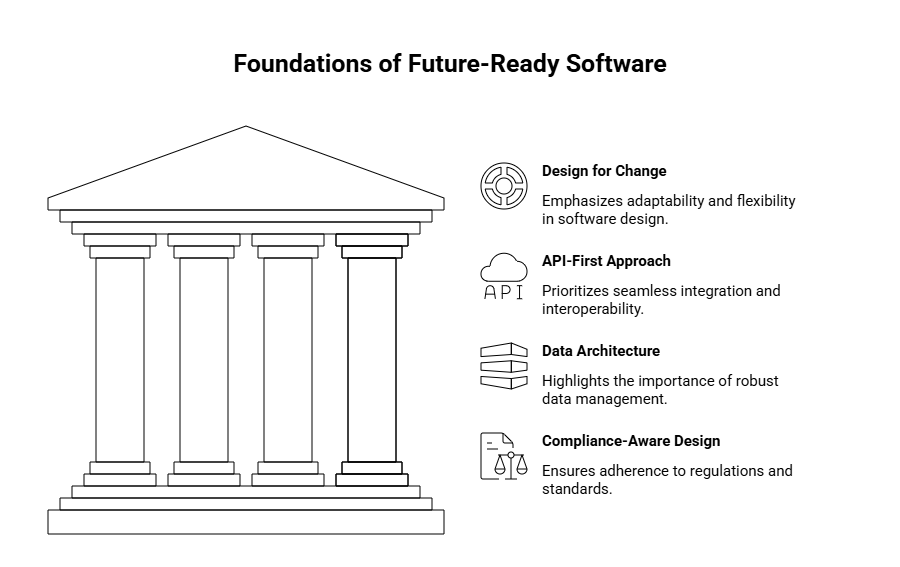
Future-ready architecture emphasizes modular domain boundaries that isolate change. When business logic is organized into clear domains with well-defined interfaces, evolution becomes localized rather than systemic. Workflows and rules benefit from configurability, allowing variation without structural alteration.
API-First and Integration-Ready Thinking
Integration readiness emerges from treating the product as part of an ecosystem rather than a closed application. Stable APIs, versioned contracts, and extension points allow external interaction without coupling internal structures to specific partners or clients. This perspective supports platform growth and partner expansion.
Data Architecture as a Foundation
Data architecture provides continuity across product evolution. Canonical models, governance layers, and clear ownership boundaries ensure data remains consistent as features diversify. Strong data foundations enable analytics, AI, personalization, and compliance without fragmentation.
Compliance-Aware by Design
Compliance-aware design treats regulation as a variable dimension rather than a fixed condition. Abstracting policy logic from core workflows allows regional variation without architectural change. As products expand geographically, adaptability becomes structural rather than reactive.
The Role of Software Product Engineering Partners
Architectural foresight benefits from experience across multiple product lifecycles, industries, and regulatory environments. Organizations building or scaling digital products often focus understandably on feature delivery and market timelines. However, aligning architecture with long-term product strategy requires a broader perspective.
Netwin approaches software product engineering with this long-term view. Architecture is designed not only for current functionality but for future scalability, integration readiness, and regulatory adaptability. Emphasis is placed on modular structures, API-led design, and data-centric foundations that enable evolution rather than restrict it.
For organizations pursuing global digital product expansion, this approach reduces the risk of architectural lock-in. Early architecture decisions shape cost curves for years; aligning them with long-term product trajectories prevents later structural constraints.
From Short-Term Build to Long-Term Product Strategy
The most resilient digital products treat architecture as a strategic asset. Decisions about system structure influence innovation speed, integration capability, scalability cost, and expansion readiness.
Products designed with extensibility scale more smoothly because change can occur without systemic disruption. Modular structures allow teams to innovate independently. Interoperable architectures integrate partners and ecosystems without redesign. Compliance-aware foundations adapt to regulatory diversity without fragmentation.
Conversely, products optimized solely for launch speed often encounter structural ceilings. Growth exposes hidden constraints, and evolution becomes costly. Organizations then face modernization initiatives that could have been mitigated through earlier architectural foresight.
Transitioning from short-term build thinking to long-term product strategy requires reframing architecture decisions as business decisions. Structure determines trajectory.
Architecture Decisions Are Business Decisions
Every architecture choice embeds assumptions about scale, integration scope, regulatory reach, and product evolution. When these assumptions prove narrow, architecture becomes constraint.
This is why architectural debt frequently precedes business friction. Expansion delays, integration challenges, modernization programs, and platform rewrites often trace back to early structural trade-offs rather than later operational failures.
Future-ready software product engineering recognizes this relationship early. It designs architectures that support change rather than resist it, and growth rather than constrain it.
Because the architecture you choose today quietly decides the problems you will face tomorrow.