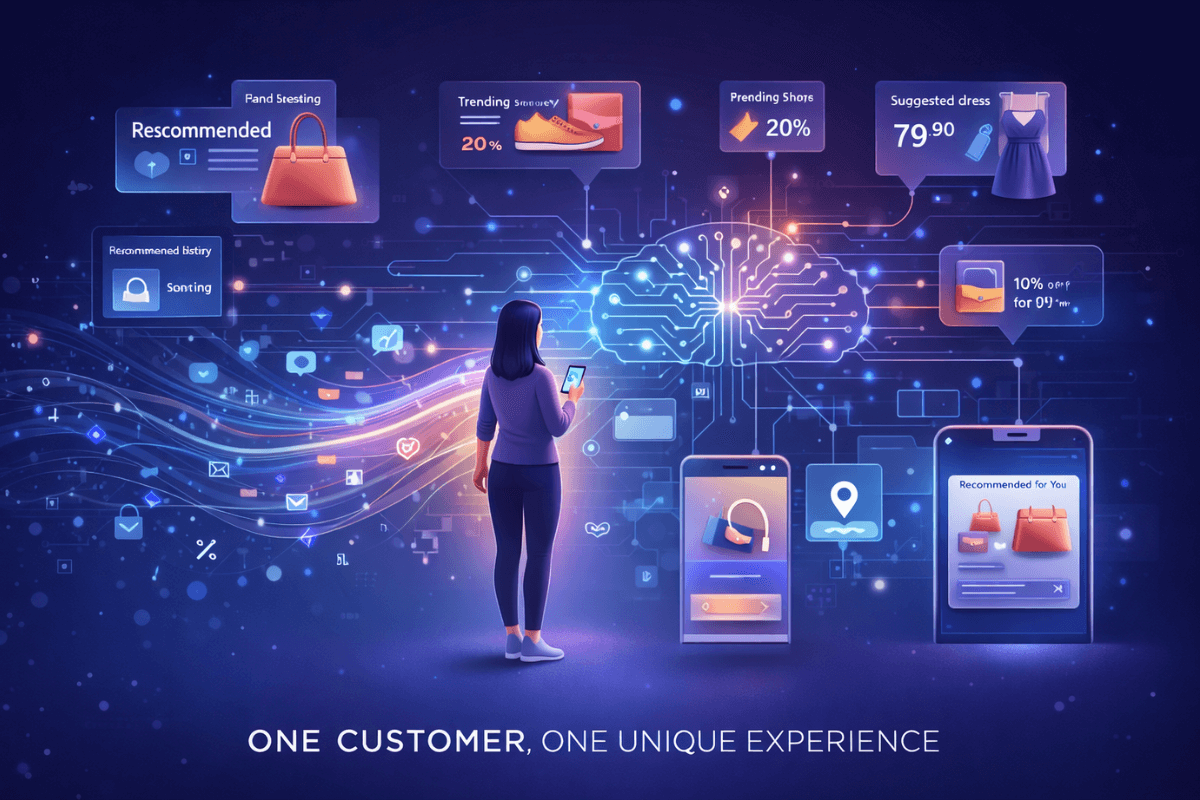
AI in retail reached a defining moment in 2025.
Artificial Intelligence stopped being a future investment or an experimental layer. It became part of everyday retail operations, quietly influencing decisions across pricing, inventory, personalization, fulfillment, and customer experience.
What made this year different was not the novelty of AI. It was the way retailers started using it.
At Netwin, working closely with retail teams on digital transformation, data platforms, and software product engineering, we saw that retailers that treated AI as infrastructure saw measurable gains, while those treating it as a side project struggled to scale impact.
This blog is a reflection on the most meaningful AI-driven shifts we observed in retail throughout 2025, what changed, why it mattered, and what retail leaders are carrying forward into 2026.

Shift 1: AI Shifted from Experiments to Embedded Retail Infrastructure
Earlier, AI lived outside the business. Tested in pilots, reviewed in dashboards, discussed in leadership meetings. In 2025, AI moved inside the operating model.
According to McKinsey, by 2025, 87% of retail leaders reported moving AI from experimentation into core business operations, with decision automation cited as the top priority rather than innovation alone.
Retailers began embedding intelligence directly into the systems that run daily operations: commerce platforms, order management, inventory systems, and supply chains. AI stopped answering questions and started influencing outcomes.
This shift fundamentally changed how retail organizations functioned:
- Decisions were no longer event-driven; they became continuous.
- Manual approvals reduced as confidence in AI systems increased.
- Execution became faster because intelligence lived where actions happened.
What changed in 2025:
- AI was designed into workflows, not layered on top.
- Decision cycles shortened across pricing, inventory, and fulfillment.
- Intelligence became operational, not advisory.
At Netwin, while developing retail software, we found that retailers who treated AI as infrastructure and not innovation, were able to scale it sustainably. The operating model mattered more than the model itself.
Shift 2: Personalization Shifted from Messaging to Decision Logic
Personalization existed before 2025, but mostly in marketing. What changed this year was where personalization happened. AI-driven personalization moved beyond content and campaigns into decision logic. Retail systems began adapting product visibility, pricing, offers, and fulfillment dynamically, based on real-time signals rather than static segments.
This evolution was powered by AI interpreting:
- Live customer behavior
- Context such as timing, location, and channel
- Inventory constraints and demand signals
- Historical response patterns
Instead of asking who a customer was, systems focused on what decision made sense now.
A research by Salesforce showed 71% of consumers now expect personalized experiences, and 76% express frustration when personalization is inconsistent across channels.
What changed in 2025
- Personalization influenced operational decisions, not just communication.
- Context mattered more than customer profiles.
- Execution adapted in real time.
We observed that Personalization only scaled where decision logic was centralized. When intelligence was fragmented, experiences felt personalized in isolation, but inconsistent end to end.
Shift 3: Planning Gave Way to Predictive Decision-Making
Retailers using AI-based demand sensing reduced stockouts by up to 30% and excess inventory by 20–25%, primarily due to earlier intervention rather than forecast accuracy – Gartner.
Retail has traditionally relied on planning cycles, weekly, monthly, seasonal. In 2025, AI disrupted this rhythm.
Retailers began shifting from static planning to predictive decision-making, where systems continuously adjusted based on emerging signals. The goal was no longer perfect forecasts, but earlier action.
AI influenced:
- Demand sensing across channels
- Inventory rebalancing between locations
- Price and promotion timing
- Supplier and fulfillment decisions
The biggest gains came not from accuracy alone, but from response speed. Our team at Netwin found that the retailers who waited for certainty lost momentum. Those who acted quickly on predictive signals consistently protected margins and availability.
Shift 4: AI in Retail Customer Experience as a System Capability
Customer experience used to be shaped primarily by design, messaging, and support teams.
In 2025, it became a system capability.
AI connected customer interactions directly to backend execution. Experiences improved not because messages were better, but because systems responded faster and more intelligently. This showed up in areas such as:
- Automated returns and refunds
- Proactive communication during disruptions
- Recommendations aligned with live inventory
- Reduced resolution times without escalation
Experience quality increasingly depended on system responsiveness, not human intervention.
What changed in 2025
- CX actions triggered operational changes.
- Friction reduced through automation.
- Consistency improved across channels.
Shift 5: Agentic AI in Retail
By 2025, many retailers had AI systems capable of generating insights and predictions. The real challenge was not knowing what to do, but acting fast enough. This is where agentic AI quietly entered the picture.
Agentic AI systems didn’t just analyze data or recommend actions. They were designed to execute decisions autonomously within predefined boundaries, turning intelligence into real-world outcomes without constant human intervention.
In retail, this mattered because of the volume and speed of decisions involved.
Agentic AI proved effective in areas where:
- Decisions were frequent and time-sensitive
- Rules and thresholds were clearly defined
- Data inputs were structured and reliable
- The cost of delay directly impacted revenue or experience
Common applications included:
- Automatically rebalancing inventory across stores
- Triggering replenishment orders within approved limits
- Adjusting prices dynamically within guardrails
- Resolving routine customer issues without escalation
Importantly, agentic AI did not replace human judgment. Strategy, brand decisions, and high-risk trade-offs remained firmly human-led.
What changed in 2025
- AI systems began executing micro-decisions autonomously
- Operational response times dropped dramatically
- Teams shifted from execution to supervision
Shift 6. Retail Technology Simplified Around Decision Speed
Another clear shift in 2025 was simplification. Retailers began reducing tool sprawl and rethinking their technology stacks around one priority: decision speed. Platforms were evaluated based on how quickly insights could turn into action.
This resulted in:
- Fewer disconnected tools
- Clearer data flows
- Faster experimentation
- More resilient systems during peak demand
AI performance improved as complexity reduced. We observed that in retail, complexity taxes intelligence. Simplified architecture enabled AI to scale without slowing the business down.
Conversely, lack of shared intelligence was cited as the top internal blocker to AI ROI in retail organizations, – Netwin.
Why AI Still Failed for Some Retailers
Despite widespread adoption, AI did not deliver results for every retailer in 2025. In most cases, the failure had little to do with model quality or algorithmic maturity. AI systems generated insights, forecasts, and recommendations, but those insights often stalled before they could influence real decisions.
Intelligence existed, but it was disconnected from execution, trapped in dashboards and delayed by manual processes that retail operations simply cannot afford.
Another major reason for failure was structural rather than technical. Many retailers attempted to layer AI onto fragmented systems, inconsistent data definitions, and legacy architecture that was never designed for real-time decision-making.
Even when data was integrated, teams did not share a common understanding of what the data represented, leading to mistrust and hesitation. AI amplified these inconsistencies instead of resolving them, making organizations more cautious rather than more confident.
Finally, organizational readiness was frequently overestimated. Retailers expected AI and in some cases agentic AI, to act autonomously without clearly defined guardrails, accountability, or decision ownership. When systems acted in unexpected ways, trust eroded quickly and human overrides returned.
At Netwin, we saw that AI succeeded only where intelligence, execution paths, and governance were designed together. Where that foundation was missing, AI did not fail loudly, it failed quietly, by never being fully used.
A Readiness Check for 2026
As retailers look ahead, a few questions matter more than technology roadmaps:
- Can your systems act on insights within minutes?
- Is decision logic embedded where execution happens?
- Do teams trust AI outputs enough to automate actions?
- Can intelligence scale during peak demand?
If the answer is no, the challenge isn’t AI, it’s the system beneath it.
Why 2025 Was the Inflection Point
2025 will be remembered not as the year retail adopted AI, but as the year intelligence became operational. Retailers moved beyond experimentation and began redesigning how decisions are made, executed, and scaled. AI shifted from generating insights to influencing real outcomes, quietly embedded into systems, workflows, and daily operations.
What separated leaders from laggards was not access to better models, but the strength of their foundations. Retailers that unified data, simplified architecture, embedded decision logic, and introduced autonomy with guardrails were able to move faster and act with confidence. Those who treated AI as a feature or overlay struggled to convert intelligence into impact.
At Netwin, we see 2025 as the inflection point where retail began engineering decision-making itself. As the industry moves into 2026, the question is no longer whether AI belongs in retail, but whether retail systems are ready to act on intelligence at scale. The answer to that question will define the next generation of retail leaders.