
Dynamic Pricing with Instant Update

Dynamic Pricing pricing with AI is becoming a critical capability for modern businesses. Markets today move faster than ever. Competitors change prices frequently, customer demand fluctuates rapidly, and supply chains shift unpredictably. In such an environment, businesses that cannot respond in instantly risk losing both revenue and relevance. Yet, many organizations still rely on slow pricing processes driven by manual analysis, delayed reports, and multi-layer approvals. At Netwin, we have previously explored how AI-driven dynamic pricing helps retailers optimize profitability. While dynamic pricing enables businesses to adjust prices based on market conditions, many organizations still struggle with a fundamental challenge: pricing reaction delays. Even when businesses have advanced analytics tools, the decision-making process often remains slow. As a result, organizations lose revenue opportunities, experience margin erosion, and struggle to remain competitive. However, the conversation is now evolving. It is no longer just about optimizing pricing. It is about executing pricing decisions without delay. This is where Agentic AI is redefining pricing. By enabling continuous monitoring, intelligent decision-making, and automated execution, businesses can move from delayed responses to dynamic pricing decisions. For organizations looking to modernize their pricing strategies, companies like Netwin are helping build intelligent pricing systems powered by AI, data analytics, and digital transformation technologies. What Is Dynamic Pricing with AI? Dynamic pricing with AI refers to the ability to continuously monitor market conditions and adjust prices instantly based on data-driven insights. Unlike traditional pricing systems that rely on periodic updates, AI-powered pricing systems analyze multiple data sources continuously, including: Customer demand patterns Competitor pricing changes Inventory levels Market trends These systems ensure that pricing decisions are always aligned with current market conditions. Netwin helps organizations build intelligent pricing systems that enable this level of responsiveness through advanced AI, data analytics, and digital transformation solutions. What Are Pricing Reaction Delays? Pricing reaction delays occur when businesses take too long to adjust prices in response to market changes. Today, pricing decisions must be made quickly. However, many organizations still rely on manual processes and delayed insights, which slow down pricing adjustments. For example, a competitor might lower their price on a popular product. Ideally, a business should detect this change immediately and respond accordingly. However, in many organizations, the change may only be noticed during the next pricing review meeting. Similarly, if customer demand suddenly increases for a product, businesses could increase prices slightly to optimize margins. But if pricing systems react slowly, the opportunity is lost. At Netwin, we work with organizations across industries that face these challenges. Many businesses have access to large amounts of data, yet they lack the systems required to analyze signals as they happen and act quickly. Pricing reaction delays often occur because pricing decisions rely on: Delayed market analysis Manual reporting processes Static pricing models Slow decision workflows These delays create a gap between market change and business response, which can significantly impact profitability. The Cost of Not Having Dynamic Pricing The absence of dynamic pricing capabilities has a direct impact on business performance. Organizations that fail to respond quickly to market changes often experience: Lost revenue opportunities Reduced profit margins Increased inventory costs Weakened competitive positioning In industries such as retail and e-commerce, pricing agility is a key differentiator. We have seen how businesses that adopt AI-driven pricing systems gain a significant advantage by responding faster and more effectively to market signals. Why Most Businesses Still Struggle with Dynamic Pricing Despite advances in analytics, many organizations still struggle to implement dynamic pricing. One of the main reasons is the continued reliance on traditional pricing systems. Organizations that still rely on traditional pricing methods often struggle to respond effectively to market changes. Manual Pricing Analysis Many pricing teams still rely on spreadsheets and periodic reports. Analysts collect data, study trends, and prepare recommendations. While this process provides valuable insights, it is inherently slow. At Netwin, we often observe that organizations spend significant time analyzing data but struggle to implement pricing changes quickly. Delayed Data Insights In many companies, pricing insights are generated daily or weekly. This delay prevents businesses from reacting to live market signals. For example, a sudden surge in product demand might occur within hours. However, if pricing teams only review reports once a week, they may miss this opportunity entirely. Static Pricing Rules Traditional pricing models often rely on fixed rules. These rules do not adapt easily to changing market conditions. AI-powered pricing systems, on the other hand, can dynamically adjust pricing strategies based on current data. Limited Market Visibility Without advanced analytics and automation, organizations struggle to monitor competitor pricing, demand fluctuations, and inventory conditions simultaneously. At Netwin, we address these challenges by helping organizations build integrated, AI-powered platforms that support continuous decision-making. To move from delayed pricing decisions to dynamic pricing, businesses need more than analytics, they need systems that can act autonomously. What Is Agentic AI and Why It Matters for Pricing Agentic AI represents a new class of artificial intelligence systems that can observe, decide, and act autonomously. Unlike traditional AI, which provides recommendations, Agentic AI can execute decisions immediately. In pricing, this means: continuously monitoring market signals evaluating pricing strategies automatically adjusting prices At Netwin, we see Agentic AI as a critical enabler of always-on business operations, helping organizations transition toward autonomous decision systems. How Agentic AI Enables Dynamic Pricing Agentic AI pricing systems help businesses eliminate delays by automating both analysis and decision-making. Instead of relying on periodic reports, these systems operate continuously. First, AI agents monitor live data streams across multiple business systems. This includes sales data, competitor pricing, customer demand signals, and inventory information. Next, machine learning models evaluate these signals and determine whether pricing adjustments are necessary. Finally, the system can recommend or automatically implement pricing changes based on predefined business objectives. We help organizations build these intelligent pricing platforms by combining AI technologies, advanced data infrastructure, and scalable software solutions. This approach ensures that pricing decisions happen at the speed of the market. Retail Use Case: Dynamic Pricing in
Software Architecture Decisions That Limit Product Scale

Software architecture decisions made in the early stages of product development rarely feel permanent. Teams are focused on delivering an MVP, validating product-market fit, and releasing features quickly. Trade-offs feel acceptable. Constraints feel temporary. The architecture seems flexible enough to evolve later. But as the product grows across users, data, integrations, and geographies, those same early architecture decisions quietly transform into structural limitations. What once enabled speed begins to restrict scale. What once simplified delivery begins to complicate change. What once supported launch begins to block expansion. This is one of the most persistent yet underestimated realities in software product engineering. The Hidden Cost of Early Architecture Decisions Architecture is often framed as a technical foundation. In practice, it is a business trajectory decision. When products are young, architecture is shaped by immediacy. Teams operate under pressure to launch quickly with limited resources and evolving requirements. Under these conditions, optimizing for short-term delivery is rational. Decisions that reduce development effort or accelerate release are prioritized, while extensibility and long-term scalability feel like future concerns. The difficulty emerges because architecture decisions do not remain localized. They propagate into code structures, data models, workflows, integration patterns, and deployment strategies. Over time, these decisions become embedded across the product’s entire ecosystem. Unlike features or interfaces, architecture cannot be redesigned incrementally without systemic impact. Once a product reaches scale, changing architecture is no longer a refactor, it becomes transformation. This distinction explains why architectural debt is more consequential than code debt. Code debt slows engineering teams. Architectural debt constrains business evolution. Why Software Architecture Decisions Become Hard to Change As software products mature, architecture accumulates inertia. What began as a flexible structure gradually becomes rigid due to its entanglement with surrounding systems and organizational realities. Early structural choices shape domain boundaries, service interactions, and data relationships. As development continues, thousands of implementation decisions assume these structures. APIs depend on them, integrations rely on them, and workflows embed them. Changing architecture eventually requires revisiting assumptions across the entire system landscape. Growth amplifies this rigidity. Mature products rarely operate in isolation; they connect to partner ecosystems, enterprise platforms, analytics pipelines, and multiple client applications. Each connection reinforces the existing architectural shape. Altering the core structure begins to affect not only internal components but external dependencies. Data further complicates change. A mature product holds years of historical records, active transactions, and regulatory obligations. Migrating architecture now involves transforming live data at scale while maintaining operational continuity. The technical complexity increases, but so does organizational risk perception. Revenue-generating systems become difficult to alter because disruption carries financial and reputational consequences. Over time, architecture becomes stable not because it is optimal, but because change feels dangerous. Organizations adapt around its limitations instead of replacing it. This is how temporary decisions become permanent constraints. Common Software Architecture Decisions That Create Future Problems Many architecture challenges originate from decisions that were entirely reasonable at the time they were made. The problem is not poor judgment but context mismatch: choices optimized for early-stage speed become misaligned with later-stage scale. Software Architecture Decisions That Prioritize Speed Over Scalability One recurring pattern is optimizing for delivery velocity through tightly coupled structures. Early products often centralize logic and embed workflows directly into code to accelerate development. This simplifies implementation but reduces modularity. As features accumulate, the architecture becomes rigid. Changes that should affect one domain begin to ripple across multiple components, slowing evolution. Ignoring Integration and Interoperability Early-stage products frequently assume a controlled environment with limited external interaction. As a result, APIs remain minimal, abstraction layers thin, and extension points absent. When ecosystem integration becomes necessary through partners, enterprise clients, or marketplaces, the architecture lacks stable boundaries. Integration turns into custom engineering rather than configuration. Underestimating Data Architecture Initial schemas often reflect immediate transactional needs without anticipating analytics, governance, or multi-domain use. Over time, duplicated entities, inconsistent definitions, and fragmented ownership create silos. As organizations seek insights or regulatory transparency, these structural weaknesses surface. Data becomes abundant but unreliable. Compliance as an Afterthought Products launched in a single region embed local regulatory assumptions directly into workflows and data structures. When expansion into new jurisdictions begins, differences in consent models, reporting requirements, and audit expectations emerge. Because compliance logic is hardcoded rather than abstracted, adaptation requires architectural change instead of configuration. Expansion slows, not because the product lacks demand, but because its structure lacks adaptability. How Software Architecture Decisions Multiply Technical Debt Technical debt is often discussed at the level of code quality. In software product engineering, however, the most consequential debt is architectural. Its impact expands with scale. As products grow in users, features, integrations, and geographic reach, architectural limitations multiply friction across the system. Performance tuning becomes harder because structural inefficiencies are systemic. Feature delivery slows because modules are tightly interdependent. Integrations become fragile because interfaces were not designed for extension. Compliance adjustments propagate across workflows because rules were embedded instead of abstracted. Teams frequently experience this as declining engineering velocity or increasing operational complexity. In reality, the underlying issue is architectural resistance. The system itself begins to oppose change. This is why architectural debt rarely appears dramatic at first. It accumulates quietly and then manifests suddenly as large-scale modernization initiatives, platform rewrites, or expansion delays. By the time it becomes visible, it is already expensive. Real-World Scenario: When Software Architecture Decisions Limit Product Growth Consider a digital lending platform originally designed for a single national market. To accelerate launch, eligibility rules, document requirements, and compliance checks were embedded directly into service logic and workflows. Reporting schemas reflected local regulatory formats, and integrations assumed domestic financial systems. The platform achieved strong adoption. As growth stabilized, expansion into new regions became the strategic priority. This is where architectural constraints surfaced. Different markets required alternative credit scoring models, varied identity verification processes, and distinct disclosure regulations. Because compliance logic was hardcoded, each regional adaptation required structural modification rather than configuration. Integration partners in new geographies demanded flexible APIs the platform could not easily provide. Data residency
Regulatory-first Product Engineering: Building Compliant and Scalable Digital Products
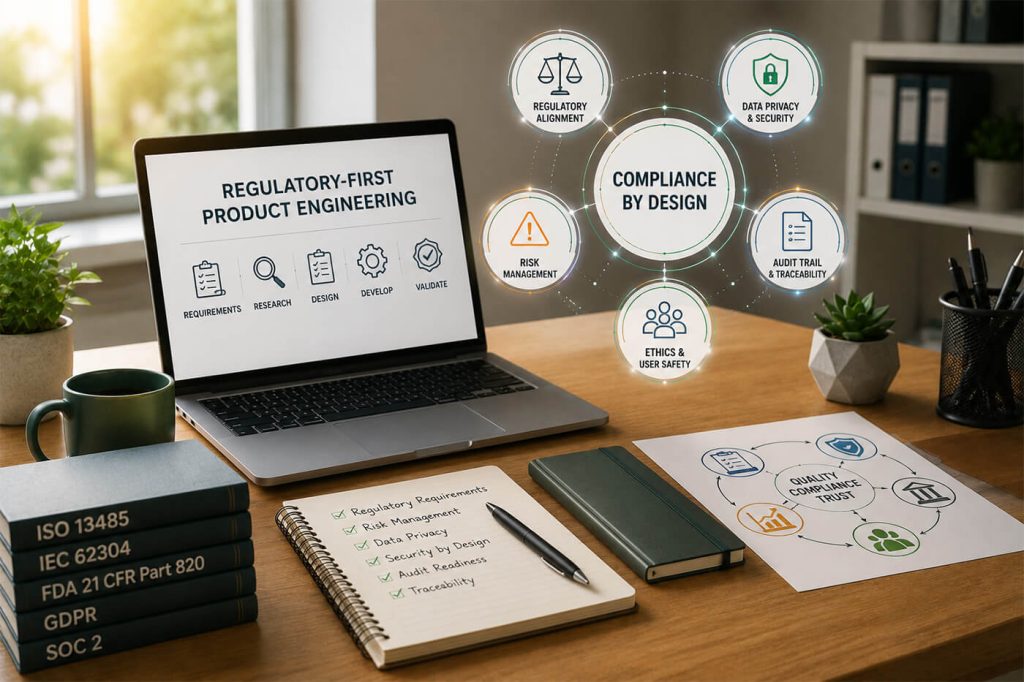
Regulatory-first product engineering is rarely planned upfront, yet it determines how long a digital product can survive in regulated markets. Regulation has fundamentally changed how digital products are built. It is no longer a late-stage checkbox or a legal formality. Instead, it has become a core design constraint that shapes architecture decisions from day one. Across fintech, healthcare, SaaS, and enterprise platforms, regulatory requirements influence every layer of a product. They affect data flows, decision logic, auditability, and even release velocity. As organizations expand globally, these challenges only intensify. At Netwin, this shift is visible across product engineering initiatives for regulated industries. Teams are no longer asking how to “add compliance later.” They are asking how to build products that remain compliant as regulations evolve. This reality has given rise to regulatory-first product engineering. It is not a framework or a toolset. It is a mindset that treats regulation as a design input, not a delivery obstacle. Understanding Regulatory-First Product Engineering in Modern Software Regulatory-first product engineering begins with a simple idea. Compliance should be engineered into the product, not layered on afterward. In traditional product development, regulation is often addressed during testing or deployment. This approach worked when regulatory changes were infrequent. However, it fails in today’s environment of constant policy updates and regional variation. A regulatory-first approach flips this sequence. It ensures systems are designed for traceability, accountability, and adaptability from the beginning. This reduces long-term risk while improving product resilience. At Netwin, regulatory-first thinking often starts at the architecture stage. Design decisions are made with audits, investigations, and future regulatory shifts in mind. As a result, products remain flexible without becoming fragile. Why Regulatory-First Product Engineering Is Now a Core Requirement? Regulation has increased in both volume and complexity. Organizations must now comply with overlapping regional, national, and industry-specific rules. For example, a single product may need to satisfy multiple data protection laws. It may also need to adapt decision logic for different markets. These changes rarely happen once. They happen continuously. As a result, product engineering teams face growing pressure. They must move quickly while maintaining strict compliance. This tension exposes the limitations of traditional engineering models. Regulatory-first product engineering addresses this challenge directly. It accepts regulation as a permanent condition. Then, it designs systems that can thrive under that condition. The Structural Risk of Hardcoding Rules: One of the biggest barriers to regulatory-first product engineering is hardcoded logic. Hardcoding regulatory rules inside application code may seem efficient initially. It allows teams to move fast during early development. However, this speed is deceptive. Over time, every regulatory update becomes a code change. Each change introduces risk, delays, and dependency on engineering availability. Small updates can trigger large regressions. From our experience in modernizing legacy platforms, this pattern is common. Hardcoded rules create brittle systems that resist change. They also make audits difficult and explanations unreliable. Therefore, eliminating hardcoded regulatory logic is a foundational step. It creates space for adaptability without sacrificing control. Separating Rules, Policies, and Decisions: Clarity is essential in regulated systems. This clarity comes from separation. In regulatory-first product engineering, rules, policies, and decisions serve different purposes. Rules define how the system operates. Policies define what is allowed or restricted by regulation. Decisions represent outcomes based on rules and policies. Separating these elements improves system transparency. It also reduces coupling between compliance and core functionality. This separation makes systems easier to reason about. At Netwin, this approach consistently improves collaboration. Engineering teams focus on stability and performance. Compliance teams gain visibility into how policies are applied. As a result, changes become safer and more predictable. Why Separation Improves Speed and Governance? Separation is not only about clarity. It directly improves speed and governance. When policies change, teams can update configurations instead of code. When decisions evolve, core systems remain untouched. This significantly reduces deployment risk. Governance also improves naturally. Rules and policies become explicit and reviewable. Audit conversations shift from reconstruction to verification. In a regulatory-first world, this capability is critical. Speed without governance creates risk. Governance without speed creates stagnation. Separation enables both. Versioned Logic and the Importance of Traceability Traceability is a non-negotiable requirement in regulated environments. Regulators do not only care about what happened. They care about why it happened. Versioned logic enables this level of accountability. It allows teams to track which rules and policies were active at any point in time. This includes historical decisions and automated outcomes. Without versioning, audits become investigative exercises. Teams rely on memory, logs, and assumptions. This creates unnecessary stress and exposure. At Netwin, traceability is designed as a core product capability. Versioned logic is treated as a feature, not documentation. This approach simplifies audits and strengthens trust. Use Case: Regulatory-First Product Engineering in a Global Fintech Platform Consider a fintech platform offering digital lending services across multiple regions. The core product handles customer onboarding, credit decisions, and transaction processing. Each of these functions is subject to different regulatory requirements. In one region, lending decisions must follow strict transparency rules. In another, data retention policies are more restrictive. Regulatory updates also arrive frequently, often with short implementation timelines. The Traditional Approach and Its Challenges Initially, the platform embedded regulatory logic directly into application code. Each regional variation required conditional logic and feature flags. Over time, the codebase became difficult to manage. When regulations changed, releases slowed down. Engineering teams had to re-test unrelated features. Audit requests required manual reconstruction of historical decisions. This approach increased operational risk and compliance overhead. Scaling into new regions became expensive and unpredictable. Applying Regulatory-First Product Engineering The platform adopted a regulatory-first product engineering approach. Rules, policies, and decisions were separated into distinct layers. Regulatory constraints were externalized from the core application. Versioned policies were introduced for each region. This allowed the team to track which rules applied at any point in time. Auditability improved without adding engineering burden. At Netwin, similar architectural shifts are often implemented during platform modernization. The focus remains on clarity, traceability, and scalability.
The Real Reason Your Loan Origination System Will Fail

Loan Origination Systems rarely collapse overnight. In fact, most of them perform reasonably well during initial rollout. The workflows function, applications get processed, approvals happen, and stakeholders feel confident about the investment. This early success often creates a false sense of security. The system appears stable, reliable, and “future-ready.” But then change arrives. It could be a new regulatory mandate, a sudden surge in loan applications, a shift in customer expectations, or the launch of a new lending product. That is when the cracks begin to show. And when they do, institutions realize that the problem was never about features or user interfaces, it was about how the system was engineered at its core. The Illusion of Stability in Traditional Loan Origination Systems Most LOS platforms are designed to solve a well-defined problem at a specific point in time. They are built around known regulations, current lending products, and predictable volumes. In controlled conditions, this approach works. However, financial services rarely operate in controlled conditions for long. As lending ecosystems grow more complex, institutions must deal with: Frequent regulatory updates Increased scrutiny on risk and compliance Integration with external fintech platforms Rapid digital adoption by customers Despite this reality, many LOS platforms continue to be designed as static systems. They assume stability where none exists. This mismatch between system design and business reality is where long-term failure begins. We have worked closely with financial institutions across different markets, and often saw the same pattern repeat itself: systems optimized for the present struggle to survive the future. Architecture Built for the Present Is the Core Problem At the heart of most LOS failures lies a fundamental architectural flaw: the system was never designed to evolve. When architecture decisions prioritize immediate requirements over long-term adaptability, institutions inherit hidden risks. These risks remain dormant until the first major change event occurs. At that point, even minor updates can trigger cascading issues across the system. Change in lending is not an exception, it is the rule. Regulatory frameworks evolve, customer behavior shifts, and competitive pressure forces institutions to innovate continuously. A Loan Origination System that cannot accommodate this reality becomes a bottleneck rather than a growth enabler. The Three Engineering Gaps That Cause LOS Failure The infographic identifies three recurring engineering gaps that consistently undermine Loan Origination Systems. These gaps are not theoretical; they are practical, structural issues observed across legacy and mid-generation platforms. 1. Hard-Coded Business Rules: Hard-coded business rules are one of the most damaging design decisions in an LOS. In such systems, critical lending logic, credit policies, eligibility checks, approval thresholds, and exception handling is embedded directly into the application code. At first, this approach appears efficient. It ensures strict control and predictable behavior. However, the moment a policy change is required, the system becomes rigid. Every update demands: Code changes Developer intervention Regression testing Deployment cycles This significantly slows down response times, especially in regulatory-driven environments where speed and accuracy are non-negotiable. Over time, institutions begin to avoid making changes altogether because of the operational risk involved. This leads to outdated policies, manual workarounds, and increased compliance exposure. Netwin’s experience across multiple digital transformation programs highlights that business rules should never be locked inside code. Flexibility must be a foundational principle, not a future enhancement. 2. Broken Data Flow: A modern Loan Origination System is deeply interconnected. It relies on real-time inputs from multiple internal and external systems, including credit bureaus, underwriting engines, core banking platforms, fraud detection tools, and CRMs. Yet many LOS platforms still operate on fragmented or batch-based data flows. This creates a dangerous gap between reality and decision-making. When data does not flow seamlessly: Credit scores may be outdated Risk assessments may be incomplete Approval decisions may be inconsistent Customer experiences may feel disjointed From a business perspective, this is not merely a technical inefficiency. It directly impacts risk quality, operational confidence, and regulatory compliance. Institutions may approve loans they should not, or reject customers they should not lose. Netwin’s system modernization work repeatedly reinforces one insight: real-time data flow is not optional for scalable lending operations. 3. Low Adaptability: Low adaptability is perhaps the most expensive problem of all, even though it often remains invisible at first. When an LOS lacks adaptability, every new requirement, be it a regulatory change, product launch, or market expansion, results in rework. Over time, this rework compounds, increasing system complexity and reducing reliability. Institutions may find themselves: Delaying product launches Running parallel manual processes Increasing dependency on IT teams Accumulating technical debt Eventually, the LOS becomes so fragile that even small changes feel risky. At this stage, institutions often face a difficult decision: continue patching the system or replace it entirely. The infographic captures this reality visually with tangled workflows and repeated “rework” cycles—a scenario many financial organizations know all too well. Why Modern LOS Thinking Has Shifted One of the most important messages in the infographic is that modern Loan Origination Systems are not defined by features. They are defined by their ability to adapt. In the past, LOS evaluations focused heavily on checklists, number of workflows supported, types of loans handled, or integration options available. While these factors still matter, they are no longer sufficient. What truly differentiates a modern LOS is how it responds to uncertainty. Netwin’s approach to engineering financial systems reflects this shift, prioritizing architectural resilience over short-term completeness. Engineering for Change: A Different Way of Building LOS Platforms The right side of the infographic outlines what it means to engineer a Loan Origination System for change. This is not about adding layers of complexity, it is about designing systems that remain stable even as everything around them evolves. Configurable Business Rule Engines Configurable rule engines separate business logic from system logic. This allows institutions to update policies, thresholds, and workflows without touching the underlying code. The impact of this approach is significant: Faster regulatory compliance Reduced operational risk Greater autonomy for business teams Shorter time-to-market for new products Instead of fearing change,
The Questions CEOs Must Answer Before Committing to a 2026 Roadmap

For many organizations, the last few years have been about survival, recovery, and adaptation. Roadmaps were built reactively, responding to market shocks, rapid digitization, and shifting customer expectations. But 2026 is different. It is not a year to experiment blindly or stack more initiatives onto an already crowded agenda. It is a year that demands clarity, focus, and intentional execution. CEOs planning their 2026 roadmap face a fundamental challenge: How do you move from doing “more digital work” to building a genuinely future-ready business? The answer doesn’t start with technology choices or budget allocations. It starts with asking the right questions, questions that reveal whether your organization is positioned to grow, adapt, and lead. Below are 10 questions every CEO should ask before locking their 2026 roadmap. Are we building for growth or just maintaining what already exists? Many roadmaps quietly prioritize stability over progress. A significant portion of investment often goes into maintaining legacy platforms, resolving workarounds, and managing the complexity accumulated over time. This question forces leaders to examine whether the organization is: Actively creating new capacity for growth, speed, and differentiation Or primarily funding the cost of standing still A growth-oriented roadmap consciously reallocates energy away from maintenance-heavy structures toward platforms and capabilities that enable expansion. Do we operate on a strong digital backbone or a collection of disconnected systems? Over years of expansion and tool adoption, most enterprises end up with fragmented technology landscapes. Each system may work in isolation, but together they create friction. This becomes visible when: Leadership struggles to get a single, reliable view of performance Teams spend time reconciling data instead of acting on it Decisions slow down because systems don’t align A 2026 roadmap should aim to reduce fragmentation and move toward a more cohesive, well-orchestrated digital foundation. Is our data enabling decisions or just documenting the past? Having dashboards and reports does not automatically mean the organization is data-driven. The real test is whether data informs decisions at the moment they are made. CEOs should assess: How trusted and consistent the data is across functions Whether insights arrive in time to influence outcomes How easily teams can act on what data reveals Roadmaps that elevate data from reporting to decision-support unlock far greater strategic value. Are we being deliberate about AI or reacting to pressure to adopt it? AI has moved from experimentation to expectation. Yet many initiatives still lack a clear purpose. This question encourages leaders to distinguish between: AI as a strategic capability that solves real problems AI as a response to market noise or internal enthusiasm A strong roadmap identifies where AI meaningfully improves decisions, automates execution, or enhances experience, and avoids scattered experimentation without ownership or outcomes. Is customer experience intentionally designed? Customer experience is often discussed in isolation, separate from systems, data, and operations. In reality, experience is the result of how well those elements work together. This question asks whether: Customer journeys are consciously designed end-to-end Experiences remain consistent across channels and touchpoints Personalization is limited by internal silos In 2026, experienced leadership will belong to organizations that engineer it deliberately and not those that leave it to chance. Can our technology adapt when the market changes unexpectedly? Change is no longer an exception; it is the baseline. New regulations, shifting demand, or sudden growth can expose weaknesses in rigid systems. CEOs should evaluate: How quickly platforms can be modified or extended Whether scaling introduces instability How dependent the organization is on tightly coupled systems A resilient roadmap prioritizes flexibility, allowing the organization to respond confidently rather than react defensively. Does technology accelerate execution or slow teams down? Internal friction often remains invisible at the leadership level until it becomes severe. This question brings attention to: Manual processes that persist despite digital tools Tool overload without integration Decision delays caused by system complexity A roadmap that improves internal velocity can have as much impact as one focused on external growth. Are our technology relationships transactional or truly strategic? As transformation becomes ongoing rather than project-based, the nature of partnerships matters more. This question helps leaders assess whether partners: Understand the business context, not just requirements Contribute to long-term thinking Can adapt as priorities evolve Strategic partners strengthen execution capacity and reduce risk across multi-year roadmaps. Do we measure success by real business impact? It is easy to track project completion. It is harder, but far more valuable to track outcomes. CEOs should reflect on: Whether initiatives are tied to clear business results How impact is measured and reviewed What happens when results fall short A mature roadmap focuses on value creation, not volume of delivery. If we made no meaningful changes, where would we realistically be by the end of 2026? This question removes optimism from the planning room. It forces leadership to run a status-quo simulation, to look past ambition and examine momentum as it truly exists today. When leaders answer it honestly, they confront: The compounding cost of delay, not just this year, but year after year Competitive gaps that widen silently, without obvious warning signs Growth opportunities lost by default, not by poor decisions, but by indecision Most roadmaps avoid this question because it exposes uncomfortable truths. The ones that face it head-on tend to be simpler, sharper, and braver. Because in fast-moving markets, standing still rarely feels like failure, until it suddenly becomes irreversible. How Netwin Helps Leaders Turn These Questions into Action Asking the right questions is the starting point. The real challenge begins when organizations attempt to translate clarity into execution, across technology, data, teams, and timelines. This is where many roadmaps struggle. Not because the vision is wrong, but because the foundation isn’t ready to support it. We work with leadership teams at this exact intersection where strategic intent meets operational reality. Rather than approaching transformation as a series of isolated projects, Netwin focuses on building connected, scalable digital foundations that support long-term business direction. In practice, this means helping organizations: Modernize legacy systems so growth
Why 2026 Will Be the Year of Unified Data Architecture

Unified Data Architecture is quickly becoming one of the most important foundations for enterprise transformation. Over the past decade, digital transformation has pushed organizations to modernize operations, adopt automation, and move workloads to the cloud. But despite these advancements, one fundamental challenge has persisted across enterprises of every size and industry: Data remains deeply fragmented. Customer data sits in CRM systems, operations data lives in ERPs, sales and marketing run on different dashboards, finance builds separate reports, and product teams gather their own telemetry altogether. Even with cloud adoption and analytics investments, most enterprises still operate with data silos, disconnected schemas, duplicated records, and inconsistent reporting. But 2026 is shaping up to be the turning point. The year organizations finally unify their data, break silos, and build a foundation that supports true intelligence. This is not a prediction based on hype. It’s based on five undeniable market shifts converging at the same time. In 2026, Unified Data Architecture (UDA) will no longer be optional, it will be the backbone of every intelligent enterprise. Let’s explore what’s driving this global shift. AI Adoption Is Accelerating AI is moving from isolated use cases to becoming an enterprise-wide capability. But the organizations seeing the most impact aren’t the ones experimenting with the latest model, they’re the ones building strong foundations underneath it. At Netwin, we consistently see a pattern across digital and AI engagements: the real barrier isn’t AI readiness, but data readiness. When data is fragmented, even the most advanced AI struggles. When data is unified, AI accelerates naturally. This shift is why enterprises in 2026 will invest heavily in Unified Data Architectures. Not for the sake of modernization, but because AI now demands it. Real-Time Decisions Is Becoming the Default Operational Standard Leaders are moving away from retrospective reports and toward real-time visibility. As enterprises evolve, the expectation for live intelligence is rising, especially in operations, supply chains, customer experience, and finance. In modernization programs we deliver at Netwin, this has become the strongest recurring theme. Enterprises no longer want dashboards that summarize the past; they want systems that interpret the present and anticipate what’s next. Unified Data Architecture makes this possible by enabling fast, consistent data flow across the entire business, something static integrations can’t support at scale. Compliance and Governance Are Becoming More Demanding Regulatory frameworks across banking, insurance, healthcare, and even retail are becoming more stringent, especially around data lineage, auditability, consent, and AI transparency. Netwin’s work with regulated industries has revealed a clear truth that fragmented data increases the cost and complexity of compliance. Unified Data Architecture gives enterprises the ability to manage governance centrally, track data movement end-to-end, and maintain clarity even as systems grow. This is why 2026 will be the year many organizations shift from reactive compliance to proactive architecture. Tool Consolidation Will Become a Strategic Goal After years of rapid SaaS adoption, enterprises are now dealing with tool sprawl, disconnected workflows, duplicated data, and escalating integration costs. CIOs and CTOs are shifting toward simplification. Not fewer tools, but smarter unification. During transformation discussions at Netwin, technology leaders increasingly ask the same thing: “How do we reduce complexity without disrupting teams already dependent on existing systems?” Unified Data Architecture provides the path forward. It brings tools together through a structured, intelligent backbone, giving the business a single view even when applications remain diverse. The Rise of Intelligent Transformation Digital transformation focused on taking offline processes online. Intelligent transformation, however, focuses on making those processes adaptive, predictive, and insight-driven. As we help enterprises transition toward intelligence, through AI-led automation, real-time insights, and modern engineering, one insight becomes clear: Intelligence doesn’t thrive on disconnected data. It thrives on unified, high-quality, continuously flowing data. That’s why 2026 will be the year enterprises treat Unified Data Architecture not as a tech initiative, but as the strategic backbone of every intelligent system they plan to build. Why Unified Data Architecture Is No Longer Optional Enterprises are realizing that fragmented data costs more than just inefficiency. It slows down innovation, limits AI adoption, creates compliance risk, and prevents leaders from seeing the full picture. Unified data architecture is becoming essential because it tackles these challenges through a single, coherent framework. A unified architecture brings: One source of truth Real-time visibility Seamless data movement Stronger governance Lower operational overhead Faster AI deployment Better customer and employee experiences It’s not just a technology upgrade; it’s an architectural shift that enables every other transformation initiative. Conclusion: The pressure for speed, intelligence, compliance, clarity, and personalization is rising. The technology to support unification is mature. And the business value is now undeniable. 2026 will not just be another year of digital advancement, it will be the year enterprises finally build the foundation that everything else depends on. And that foundation is Unified Data Architecture. If your organization is planning its next transformation chapter and wants to strengthen the foundation behind AI, analytics, and intelligent operations, we’d be glad to share what we’re seeing across industries. Let’s explore how Unified Data Architecture can accelerate your 2026 strategy.
The Software Product Engineering Behind a Modern Industrial Maintenance Platform

In industries such as shipbuilding, construction, manufacturing, and facility maintenance, coordinating maintenance tasks from routine repairs to large-scale refits or new builds can quickly become overwhelming. Without a unified system, teams struggle with disjointed workflows, miscommunication, delays in procurement, lack of visibility, and compliance issues. Yet, most enterprises still rely on spreadsheets, emails, siloed tools, paper-based logs, and unstructured work instructions. This leads to inefficiencies, delays, mismatched procurement, miscommunication, and compliance gaps. To solve this, Netwin’s software product engineering team designed a unified industrial maintenance software platform that centralizes maintenance planning, procurement, asset mapping, documentation, and collaboration, giving decision-makers complete operational visibility. This blog presents a real case study of how a multi-industry enterprise adopted this solution to drive efficiency, traceability, and cost control. The Problem: High Complexity, Low Visibility Before using the platform, the organization faced a familiar set of challenges seen across maintenance-heavy companies: Fragmented Data & Disconnected Workflows Teams used different tools to track work lists, long-term projects, spare parts, purchases, and inspections, none of which talked to each other. Communication Breakdowns Project managers, contractors, surveyors, and in-house technicians often lacked real-time updates. Tasks were missed, duplicated, or delayed. Lack of Traceability There was no unified history of: what was repaired, who completed it, which part was used, or how costs changed over time. This created bottlenecks in compliance, audits, and safety reviews. Procurement Inefficiencies Incorrect part identification, missing technical specs, and manual entries often led to wrong orders or expensive returns. Zero Spatial Visibility For assets like ships, heavy machinery, or large facilities, tasks were not mapped onto layouts. Teams lacked location context, causing delays and confusion. Limited Mobility for On-Site Teams Technicians working remotely, offshore, or on shop floors couldn’t access or update tasks on the go. The result? Cost overruns, slow decision-making, compliance gaps, and inconsistent maintenance outcomes. The Solution: A Fully Integrated Industrial Maintenance Software Platform To unify workflows, strengthen asset governance, and modernize operations, the organization deployed a comprehensive industrial maintenance platform. The platform integrates all critical maintenance and procurement processes into one intelligent ecosystem. Unified Project & Work List Management Most maintenance operations fail because projects and day-to-day tasks run on separate, disconnected systems. Netwin’s product engineering team structured the platform to separate long-term project cycles from day-to-day work lists, giving decision-makers both high-level oversight and granular control. We engineered dual-layer task architecture for project lists & work lists. Built interconnected workflows linking tasks, assets, procurement, and documentation. Enabled dynamic progress tracking, dependencies, and approvals. Now, the system: Manages long-term project plans Manages daily work lists (repairs, inspections, emergency tasks, safety checks). Tracks approvals, deadlines, dependencies, responsible teams, and progress updates. Links tasks to asset components, locations, drawings, or purchase items. Decision-makers can now view everything, from big-picture project progress to the smallest task detail without switching between tools or chasing teams for updates. Special Purchase & Procurement Automation Procurement is often the largest source of delays and errors. Our automated procurement engine was integrated to ensure accuracy and speed across all purchase cycles. The system allows technicians to initiate purchase requests directly from tasks. Centralizes specifications, photos, part numbers, and vendor details. Includes OCR (Optical Character Recognition) to read serial numbers from photos, reducing manual errors. Tracks quotes, vendor selection, approvals, purchase orders, and delivery status. Automatically links purchased parts back to the maintenance task for audit traceability. Now, the procurement no longer depends on guesswork or memory. Every detail is captured, every request is standardized, and every purchase is tracked. Asset Mapping with GA (General Arrangement) Integration Netwin introduced an interactive General Arrangement (GA) module to give leaders geographical insight into task distribution across ships, plants, facilities, or large equipment layouts. The unified platform lets users upload GA plans, blueprints, or layout diagrams of ships, buildings, plants, or factories. Enables teams to pin maintenance tasks directly onto the layout. Supports multiple views: deck-wise, floor-wise, section-wise, or component-wise. Allows users to annotate diagrams with photos, comments, and additional notes. This elevated the entire maintenance process by transforming static plans into living, actionable intelligence. Real-Time Communication & Collaboration Maintenance involves coordination between internal teams, external contractors, vendors, and safety inspectors. Miscommunication can create major delays and safety risks. We integrated a collaboration system built for enterprise-scale communication. This ensured that every stakeholder, internal or external, works in sync, accelerating work execution and reducing friction. The System enables live task updates with timestamps, comments, attachments, and approvals. Tracks conversations between technicians, engineers, contractors, and managers, all in one place. Sends automated reminders and deadline alerts. Allows contractors to access only the tasks assigned to them (controlled permissions). Keeps all communication tied to the task, eliminating long email trails. Visual Reporting & Annotation Tools In maintenance, a picture is more powerful than a paragraph. It reduces ambiguity, confirms the extent of a problem, and provides clear evidence for audits. The system now: Allows uploading photos, videos, sketches, and annotated images. Supports before/after comparison. Enables marking specific damage areas or instructions visually. Generates structured visual reports for managers, auditors, and clients. Executive Dashboards & Analytics Maintenance generates immense amounts of data, but without structure, it’s useless. Leaders need actionable insights, not just raw numbers. We ensured that leadership teams get real-time visibility through powerful analytics and dashboards. The system offers high-level dashboards for executives and operational dashboards for managers. Tracks metrics such as: Task completion rates Delays and bottlenecks Procurement cycles and cost overruns Critical asset health Contractor performance Maintenance backlog Provides filters for asset type, project, date, location, team, or vendor. Supports export for board presentations, audits, and compliance reporting. Compliance, Traceability & Audit Readiness Maintenance-heavy sectors must maintain stringent records for safety, environmental, and regulatory compliance. Netwin’s unified maintenance management system helped teams stay compliant without extra administrative effort. Auditors get clarity instantly. Logs every action with timestamps and user identity. Keeps historical records of tasks, parts used, images, inspections, and approvals. Generates audit-ready reports with a single click. Maintains complete traceability from problem identification to closure. Scalability & Customization Netwin’s
AI in Retail: How AI Is Transforming Retail Every Day

Think AI in retail is all about robot cashiers and futuristic stores? Think again. Chances are, during your last shopping trip, whether in-store or online, you engaged with Artificial Intelligence without even realizing it. Maybe it was a product recommendation that hit the mark, a discount code that arrived just in time, or even the surprising availability of a hot-selling item. Behind the scenes, AI is already running the show in modern retail. It’s not loud or flashy, it’s seamless, strategic, and deeply embedded. From smarter stock management to hyper-personalization, AI is transforming everyday retail operations in ways that deliver real, measurable business outcomes. At Netwin, we help retailers go beyond the buzzwords and build AI-ready ecosystems that work in the real world. AI in Retail: Stock Management Gone are the days of relying solely on historical data and gut feelings for inventory planning. AI in retail has revolutionized stock management: Intelligent Demand Forecasting: AI algorithms analyze vast datasets (past sales, seasonality, promotions, weather patterns, even social media trends) to predict customer demand with remarkable accuracy. Automated Restocking: Based on forecasts and real-time inventory levels, AI systems can automatically trigger reorder points, ensuring optimal stock levels. Real-Time Monitoring: Sensors and computer vision can monitor shelf availability, detect misplaced items, and even identify potential shrinkage or theft patterns, alerting staff immediately. The Benefits?