
Dynamic Pricing pricing with AI is becoming a critical capability for modern businesses. Markets today move faster than ever. Competitors change prices frequently, customer demand fluctuates rapidly, and supply chains shift unpredictably. In such an environment, businesses that cannot respond in instantly risk losing both revenue and relevance.
Yet, many organizations still rely on slow pricing processes driven by manual analysis, delayed reports, and multi-layer approvals.
At Netwin, we have previously explored how AI-driven dynamic pricing helps retailers optimize profitability. While dynamic pricing enables businesses to adjust prices based on market conditions, many organizations still struggle with a fundamental challenge: pricing reaction delays.
Even when businesses have advanced analytics tools, the decision-making process often remains slow. As a result, organizations lose revenue opportunities, experience margin erosion, and struggle to remain competitive.
However, the conversation is now evolving.
It is no longer just about optimizing pricing. It is about executing pricing decisions without delay.
This is where Agentic AI is redefining pricing. By enabling continuous monitoring, intelligent decision-making, and automated execution, businesses can move from delayed responses to dynamic pricing decisions.
For organizations looking to modernize their pricing strategies, companies like Netwin are helping build intelligent pricing systems powered by AI, data analytics, and digital transformation technologies.
What Is Dynamic Pricing with AI?
Dynamic pricing with AI refers to the ability to continuously monitor market conditions and adjust prices instantly based on data-driven insights.
Unlike traditional pricing systems that rely on periodic updates, AI-powered pricing systems analyze multiple data sources continuously, including:
- Customer demand patterns
- Competitor pricing changes
- Inventory levels
- Market trends
These systems ensure that pricing decisions are always aligned with current market conditions. Netwin helps organizations build intelligent pricing systems that enable this level of responsiveness through advanced AI, data analytics, and digital transformation solutions.
What Are Pricing Reaction Delays?
Pricing reaction delays occur when businesses take too long to adjust prices in response to market changes.
Today, pricing decisions must be made quickly. However, many organizations still rely on manual processes and delayed insights, which slow down pricing adjustments.
For example, a competitor might lower their price on a popular product. Ideally, a business should detect this change immediately and respond accordingly. However, in many organizations, the change may only be noticed during the next pricing review meeting.
Similarly, if customer demand suddenly increases for a product, businesses could increase prices slightly to optimize margins. But if pricing systems react slowly, the opportunity is lost.
At Netwin, we work with organizations across industries that face these challenges. Many businesses have access to large amounts of data, yet they lack the systems required to analyze signals as they happen and act quickly.
Pricing reaction delays often occur because pricing decisions rely on:
- Delayed market analysis
- Manual reporting processes
- Static pricing models
- Slow decision workflows
These delays create a gap between market change and business response, which can significantly impact profitability.
The Cost of Not Having Dynamic Pricing
The absence of dynamic pricing capabilities has a direct impact on business performance. Organizations that fail to respond quickly to market changes often experience:
- Lost revenue opportunities
- Reduced profit margins
- Increased inventory costs
- Weakened competitive positioning
In industries such as retail and e-commerce, pricing agility is a key differentiator. We have seen how businesses that adopt AI-driven pricing systems gain a significant advantage by responding faster and more effectively to market signals.
Why Most Businesses Still Struggle with Dynamic Pricing
Despite advances in analytics, many organizations still struggle to implement dynamic pricing. One of the main reasons is the continued reliance on traditional pricing systems.
Organizations that still rely on traditional pricing methods often struggle to respond effectively to market changes.
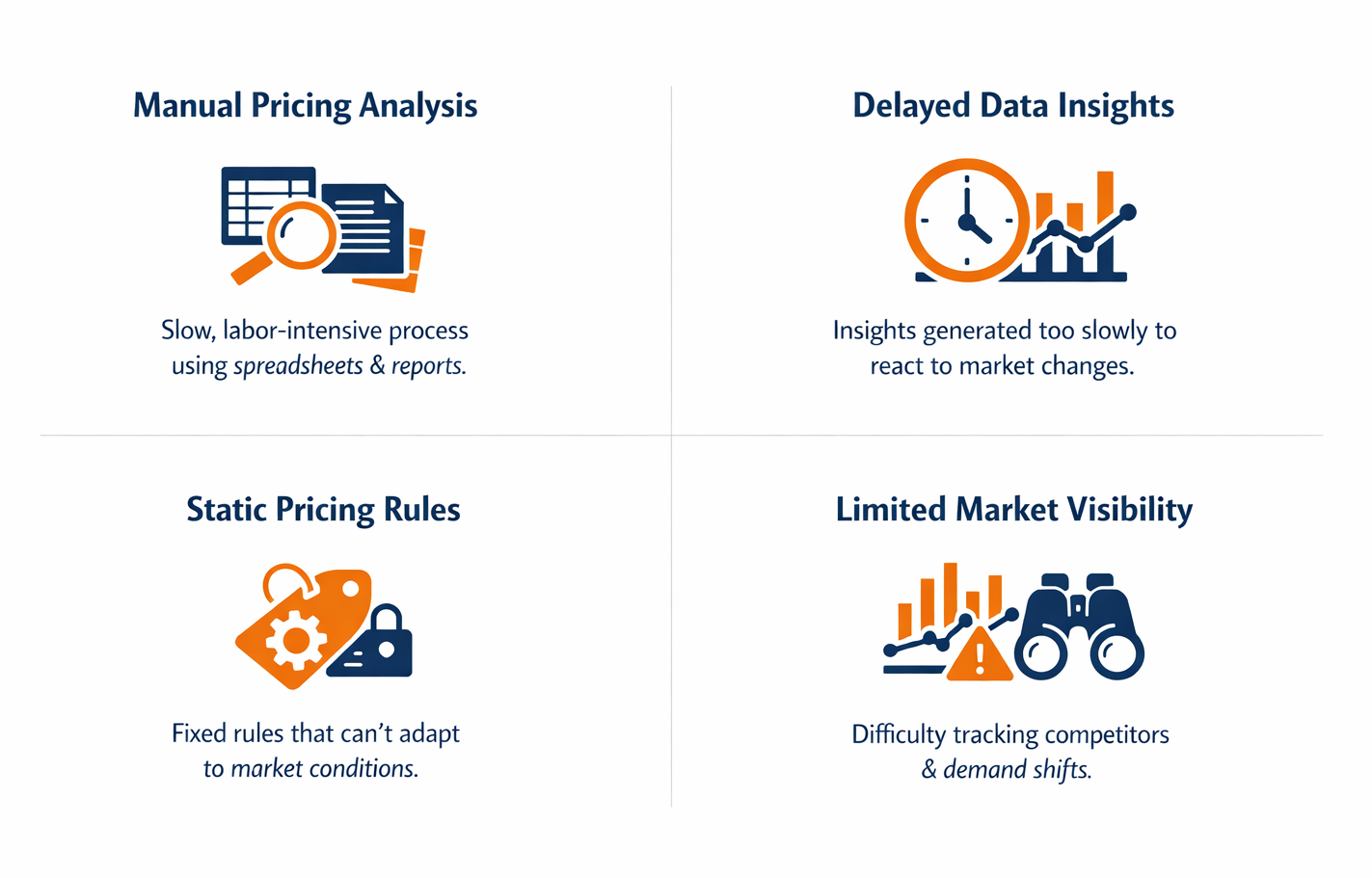
Manual Pricing Analysis
Many pricing teams still rely on spreadsheets and periodic reports. Analysts collect data, study trends, and prepare recommendations. While this process provides valuable insights, it is inherently slow.
At Netwin, we often observe that organizations spend significant time analyzing data but struggle to implement pricing changes quickly.
Delayed Data Insights
In many companies, pricing insights are generated daily or weekly. This delay prevents businesses from reacting to live market signals.
For example, a sudden surge in product demand might occur within hours. However, if pricing teams only review reports once a week, they may miss this opportunity entirely.
Static Pricing Rules
Traditional pricing models often rely on fixed rules. These rules do not adapt easily to changing market conditions.
AI-powered pricing systems, on the other hand, can dynamically adjust pricing strategies based on current data.
Limited Market Visibility
Without advanced analytics and automation, organizations struggle to monitor competitor pricing, demand fluctuations, and inventory conditions simultaneously.
At Netwin, we address these challenges by helping organizations build integrated, AI-powered platforms that support continuous decision-making.
To move from delayed pricing decisions to dynamic pricing, businesses need more than analytics, they need systems that can act autonomously.
What Is Agentic AI and Why It Matters for Pricing
Agentic AI represents a new class of artificial intelligence systems that can observe, decide, and act autonomously. Unlike traditional AI, which provides recommendations, Agentic AI can execute decisions immediately.
In pricing, this means:
- continuously monitoring market signals
- evaluating pricing strategies
- automatically adjusting prices
At Netwin, we see Agentic AI as a critical enabler of always-on business operations, helping organizations transition toward autonomous decision systems.
How Agentic AI Enables Dynamic Pricing
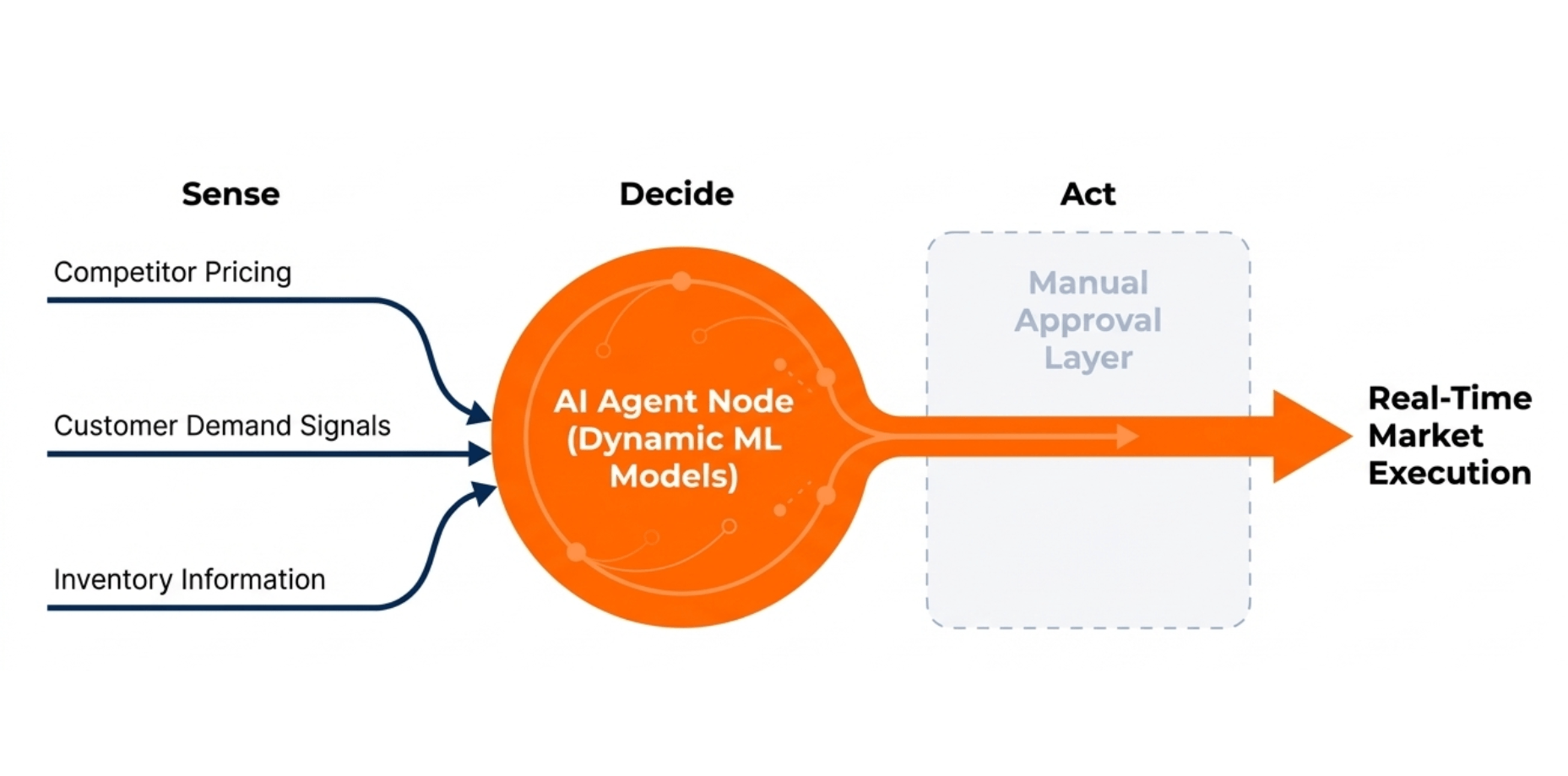
Agentic AI pricing systems help businesses eliminate delays by automating both analysis and decision-making.
Instead of relying on periodic reports, these systems operate continuously.
First, AI agents monitor live data streams across multiple business systems. This includes sales data, competitor pricing, customer demand signals, and inventory information.
Next, machine learning models evaluate these signals and determine whether pricing adjustments are necessary.
Finally, the system can recommend or automatically implement pricing changes based on predefined business objectives.
We help organizations build these intelligent pricing platforms by combining AI technologies, advanced data infrastructure, and scalable software solutions.
This approach ensures that pricing decisions happen at the speed of the market.
Retail Use Case: Dynamic Pricing in a Competitive Omnichannel Environment
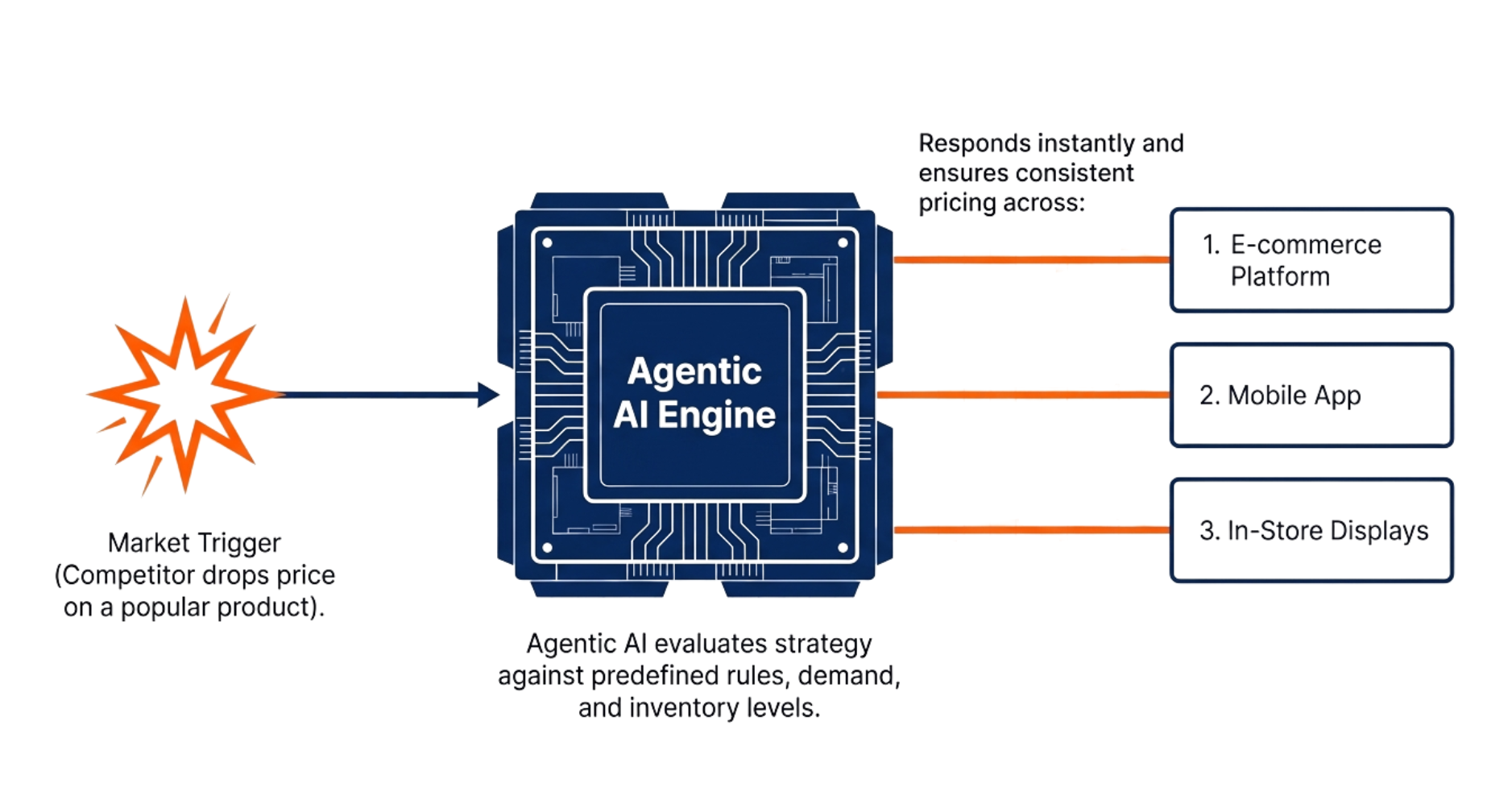
In retail, pricing decisions must adapt quickly to constant market changes.
For example, when a competitor drops the price of a popular product, traditional systems take hours or even days to respond due to manual analysis and approval workflows.
With Agentic AI, this process becomes instantaneous.
The system continuously monitors:
- competitor pricing
- customer demand
- inventory levels
It then evaluates pricing strategies based on predefined business rules and automatically adjusts prices across channels.
As a result, retailers can:
- respond instantly to competitor price changes
- optimize margins based on demand
- ensure consistent pricing across online and offline platforms
At Netwin, we enable retailers to implement such intelligent pricing systems by combining live data, AI models, and automated decision-making.
The outcome is simple: pricing decisions happen at the speed of the market.
Building Dynamic Pricing Systems with Netwin
Implementing Agentic AI pricing requires a strong technological foundation.
Organizations need systems that can collect large volumes of data, process signals on the fly and integrate pricing decisions into operational workflows.
We help organizations design and implement intelligent pricing platforms that include:
- advanced data pipelines
- live analytics capabilities
- AI-powered decision models
- seamless integration with enterprise systems
Our expertise in AI, data analytics, and digital transformation allows organizations to move from traditional pricing methods to autonomous, AI-driven pricing systems.
The Future of Pricing: Autonomous Decision Systems
The future of pricing lies in autonomous decision systems based on defined guidelines by retailers so that the entire profit is not wiped out.
Instead of relying on slow manual processes, businesses will increasingly adopt AI-driven platforms that continuously analyze market signals and execute decisions automatically.
These systems will help organizations adapt faster to market changes, optimize profitability, and maintain competitive advantage.
We believe that the evolution of pricing will move through three stages:
Traditional pricing
AI-assisted pricing
Autonomous AI pricing
Organizations that embrace this transformation early will be better positioned to compete in increasingly dynamic markets.
Conclusion
Dynamic pricing is becoming a core capability for businesses operating in dynamic markets. Organizations that rely on slow pricing processes risk falling behind competitors who can respond instantly to market changes.
Agentic AI changes this equation.
By enabling continuous monitoring, intelligent decision-making, and automated execution, businesses can move from delayed reactions to dynamic pricing strategies.
At Netwin, we help organizations build the systems required to make this transition, unlocking faster decisions, improved margins, and stronger competitive positioning.
The future of pricing is not about reacting faster.
It is about responding in the moment with intelligence powered by Agentic AI.