
It Is 3 AM at a Steel Plant. Nobody Is Watching. Everything Is Fine.
Agentic AI in manufacturing is making scenes like this possible right now. Somewhere on a factory floor, Turbine Unit 7 has just developed a subtle vibration anomaly. No alarm has sounded. No operator has been called. But within milliseconds, an AI agent has already detected the deviation, pulled up the machine’s full maintenance history, predicted a bearing failure 72 hours out, scheduled a maintenance window, ordered the replacement part from an approved supplier, and adjusted the production schedule to minimize downtime.
By the time the morning shift arrives, a work order is waiting. The part is on its way. And the line never stopped.
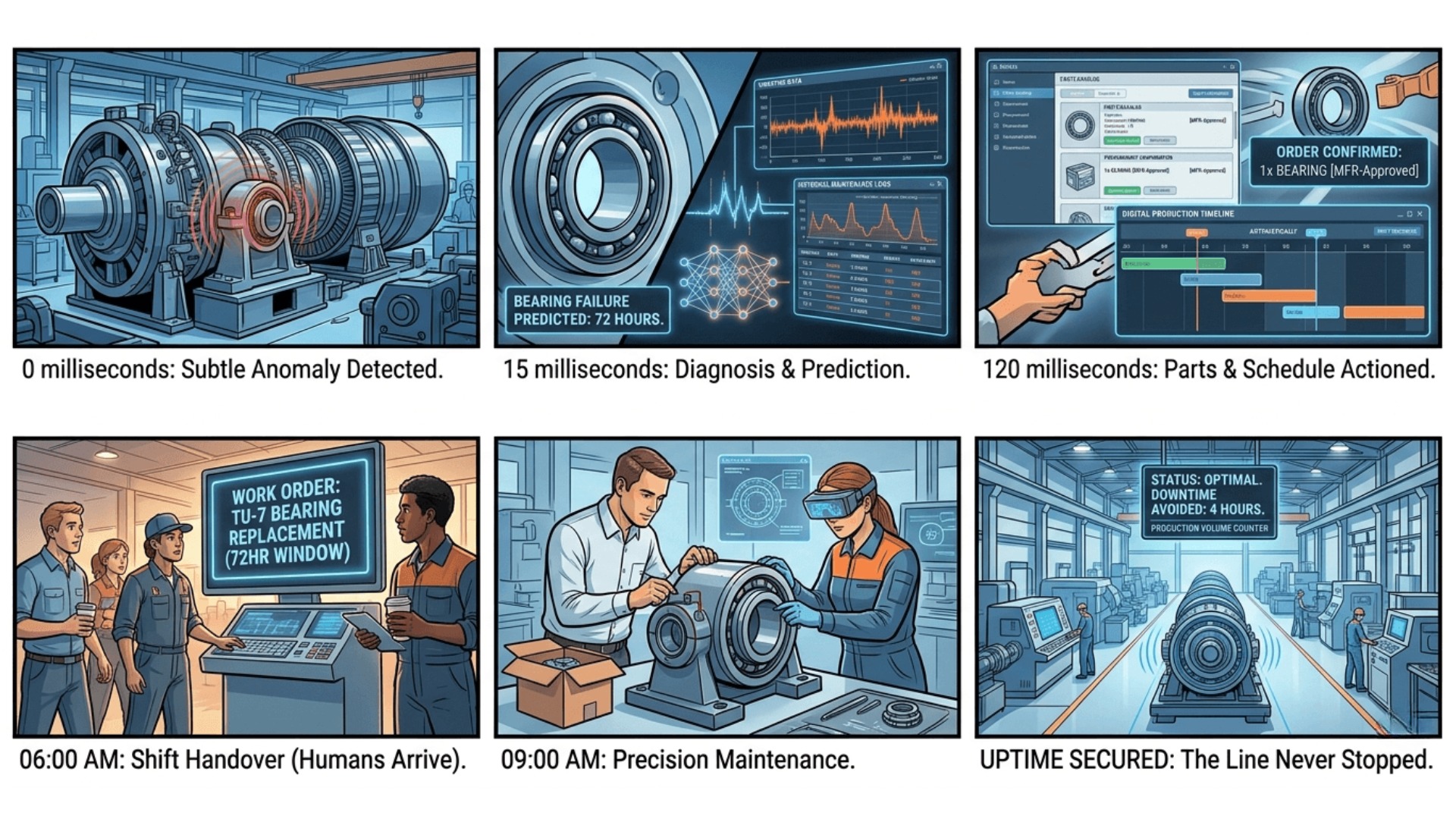
This is not science fiction. This is agentic AI in manufacturing, and it is reshaping how the world makes things.
What Is Agentic AI in Manufacturing, and Why Does It Matter?
Before exploring what it is doing on factory floors, it helps to understand what makes agentic AI different from the tools that came before it.
Traditional AI analyzes data and surfaces insights. Generative AI creates content and recommendations. Agentic AI does something fundamentally different: it pursues defined outcomes by coordinating decisions, taking actions, and orchestrating processes across planning, production, and execution, often without any human prompting at each step. MIT Sloan’s explainer on agentic AI offers a thorough breakdown of how these systems work at a technical and organizational level.
A standard AI system might tell a plant manager that a conveyor motor is likely to fail within the week. An agentic AI system will schedule the maintenance, notify the supplier, update the ERP, and adjust the shift roster, all as one continuous, autonomous workflow.
The difference between insight and action is the difference between knowing your supply chain is at risk and actually rerouting it before the disruption hits.
Why 2026 Is the Turning Point for Agentic AI in Manufacturing
For years, manufacturers treated AI as something to experiment with. Pilot projects. Proof-of-concept trials. That era is ending fast.
Deloitte’s 2026 Manufacturing Industry Outlook predicts agentic AI adoption in manufacturing will grow fourfold by 2026, from 6% to 24%. Gartner forecasts that 40% of enterprise applications will have integrated task-specific AI agents by 2026, compared to less than 5% just a year earlier. IBM found that more than half of supply chain executives surveyed are already deploying AI agents to automate workflows.
Three converging pressures explain why agentic AI in manufacturing is no longer optional for serious operators.
Supply chain volatility is at historic highs. Geopolitical tensions, tariff uncertainty, and climate-driven disruptions have made quarterly supply chain reviews completely obsolete. Manufacturers need systems that can sense, decide, and act in real time.
A generation of expertise is walking out the door. Skilled tradespeople are retiring at scale, taking decades of undocumented knowledge with them. No training program replaces institutional memory at the speed it is being lost.
The cost of standing still is rising. The global manufacturing industry loses over $50 billion annually to unplanned downtime and operational inefficiencies. In this environment, a “wait and see” approach to AI is not cautious. It is a risk.
Four High-Impact Applications of Agentic AI on the Factory Floor
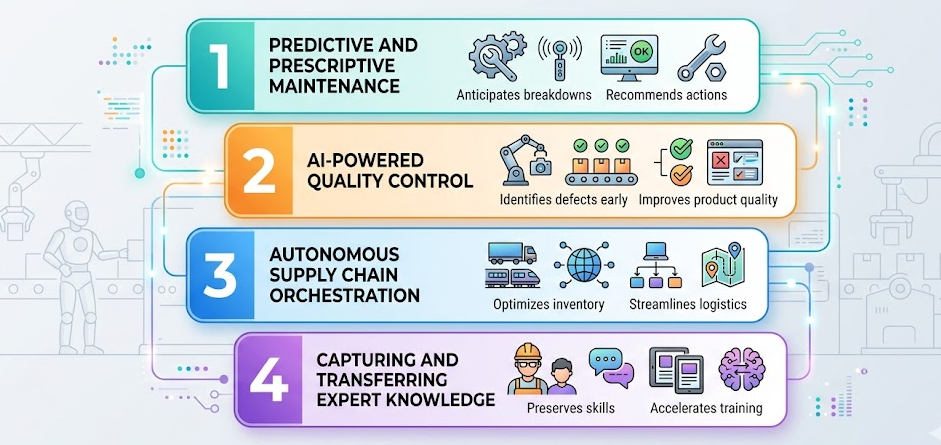
1. Predictive and Prescriptive Maintenance
Traditional maintenance is reactive: something breaks, you fix it. Predictive maintenance was a step forward. Agentic AI goes further still, into prescriptive maintenance.
An agentic system does not just predict when a failure will occur. It specifies the part, the timeframe, and the exact action required, then takes that action autonomously. A ceramics manufacturer using a multi-agent predictive maintenance framework achieved 94% predictive accuracy, a 67% reduction in false positives, and a 43% decrease in unplanned downtime, with a payback period of just 1.6 years.
What makes this possible is how these agents learn. Unlike rule-based systems that fire alerts when readings cross a fixed threshold, agentic AI learns the unique personality of each individual machine. Pump A might run hot but reliably. Pump B shows early stress through subtle acoustic changes. The agent understands the difference. A fixed-threshold system would miss one, or overfire on the other.
2. AI-Powered Quality Control
Human inspectors are skilled, but fatigue and the sheer volume of a modern production line make consistent quality control at scale nearly impossible.
Computer vision agents can inspect every single unit at full production speed. They detect microscopic cracks, color deviations as small as 0.1%, and dimensional variations measured in thousandths of an inch. They flag issues, route defective products, and feed data back into the process so root causes are addressed, not just symptoms.
Boeing provides a compelling real-world example. Facing quality challenges across one of the world’s most complex production environments, the company introduced AI-driven inspections and digital twins for its 787 Dreamliner program. The result was a significant reduction in defects and assembly times cut nearly in half.
3. Autonomous Supply Chain Orchestration
The supply chain is where agentic AI in manufacturing may deliver its most dramatic near-term value.
Consider what happens when a tariff change affects a key component. In a traditional operation, a procurement manager discovers the issue, escalates it, convenes meetings, and waits for approvals. The process takes days. Production is at risk.
An agentic system handles the same event differently. It detects the regulatory change, evaluates the full bill of materials at a component level, scores alternative suppliers against price, lead time, and reliability, and begins rerouting orders, all within minutes. Deloitte’s agentic supply chain report found that AI agents can autonomously trigger supplier follow-ups, adjust schedules, and update work orders without a human touching the process at each step.
Gartner estimates that by 2030, around 50% of cross-functional supply chain management solutions will use intelligent agents for autonomous decision-making. The manufacturers building that capability today are not just solving today’s problems. They are building a structural advantage.
4. Capturing and Transferring Expert Knowledge
One of the most urgent and underappreciated applications of agentic AI in manufacturing is preserving the knowledge that is about to walk out the door.
A master maintenance technician who has spent 30 years learning exactly how a particular press sounds when a seal is about to go carries knowledge that lives entirely in her head. When she retires, it is gone.
Agentic AI is changing that. Systems now record expert technicians performing tasks and convert those recordings into step-by-step standard operating procedures and augmented reality guides usable by anyone on the floor. One early adopter described a junior technician wearing AR glasses connected to an AI agent that listens to a machine in real time, then surfaces the exact repair video recorded by a retiring expert three years earlier. What once took years of apprenticeship now takes months of AI-assisted learning.
The Human Side: Elevation, Not Elimination
No discussion of agentic AI in manufacturing is complete without addressing what it means for the people on the floor.
The nature of work is changing, but the direction is not elimination. It is an elevation. Work shifts from doing the task to supervising decision quality: defining guardrails, monitoring exceptions, tuning agents, and stepping in where human judgment is genuinely irreplaceable.
The challenge is that most manufacturers are not investing adequately in this transition. Deloitte found that 93% of AI investment goes into the technology itself, while only 7% goes toward people. As Deloitte’s Victor Reyes put it: “You can throw all this technology in the mix, but if you’re not really taking the time to co-create a new set of roles with your workforce, you’re creating risk.”
The manufacturers getting this right run their workforce redesign in parallel with their technology deployment, not six months after it.
What Is Slowing Agentic AI Adoption in Manufacturing
The potential is clear. But the gap between potential and production reality is wider than most vendors admit.
Deloitte’s 2025 research found that while 68% of organizations are exploring or piloting agentic solutions, only 11% are actively using them in production. MIT Sloan research found that just 5% of AI projects reach scale across industries. Three obstacles explain most of the gap.
Legacy systems were not built for agents. Traditional ERP and MES platforms depend on API connections that create bottlenecks and limit what agents can do autonomously. Bridging that gap is unglamorous and expensive, but it cannot be skipped.
Data readiness is the hidden bottleneck. MIT research found that 80% of real implementation work is consumed by data engineering, governance, and workflow integration, not model tuning. Agents are only as good as the data they work with.
Ambition outpaces readiness. Gartner has predicted that over 40% of agentic AI projects will be cancelled by the end of 2027 because organizations tried to automate too much too fast. The manufacturers succeeding are starting narrow, proving value, and scaling methodically.
A Practical Roadmap for Agentic AI in Manufacturing: From Pilot to Production
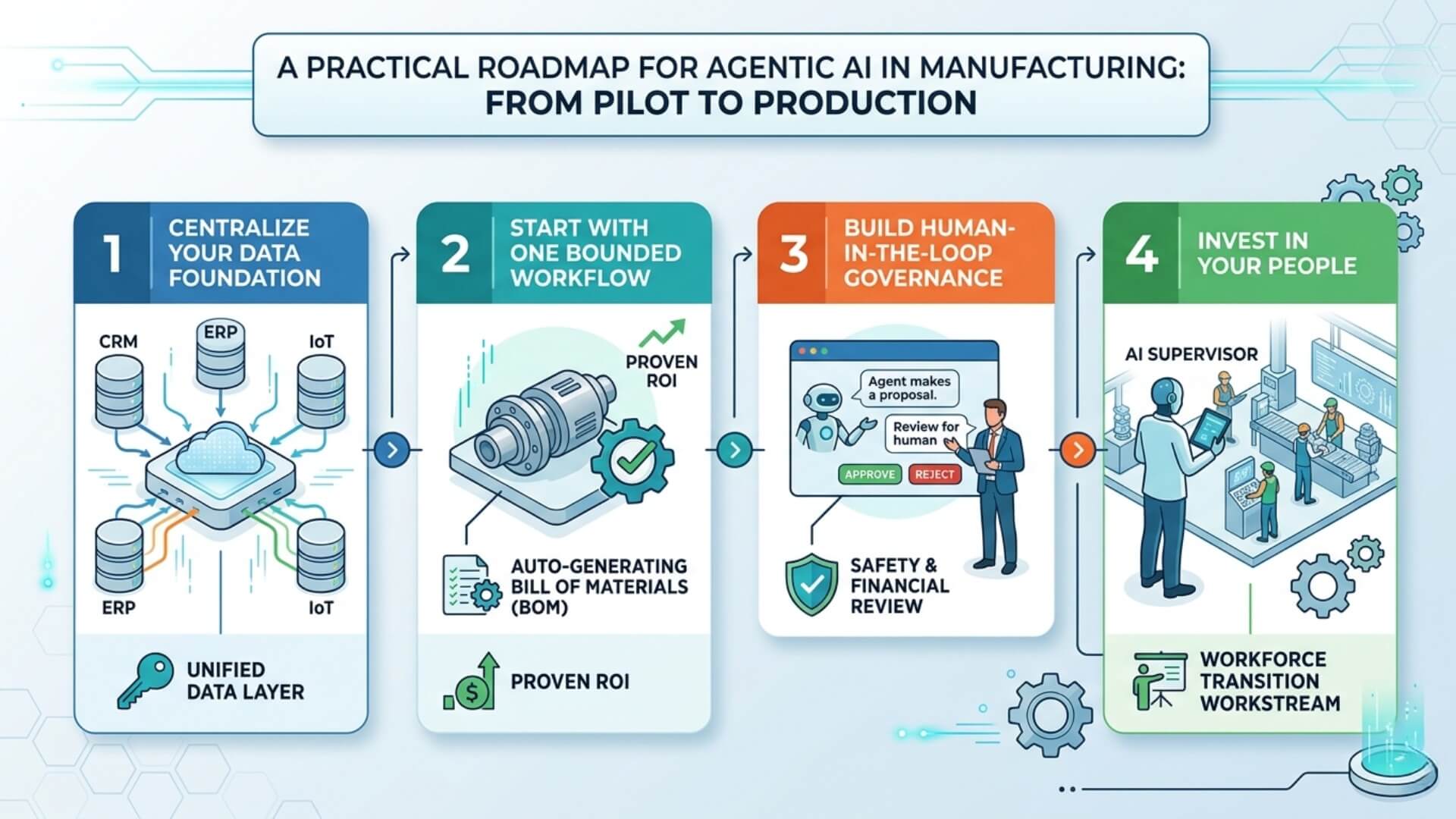
Step 1: Centralize your data foundation. Break down silos between CRM, ERP, and IoT into a single governed platform. Agents need context to act. Without a unified data layer, you are building on sand.
Step 2: Start with one bounded, high-frequency workflow. Pick a use case narrow enough to move quickly but valuable enough to show ROI. Auto-generating a bill of materials for common maintenance triggers is a proven starting point. Win there first, then expand.
Step 3: Build human-in-the-loop governance before you need it. Define which decisions require human validation before an agent acts. Safety-critical actions and significant financial commitments should always trigger a human review. Design this from day one, not after something goes wrong.
Step 4: Invest in your people at the same pace as your technology. Define what the new roles look like. What does an AI supervisor on the factory floor actually do? Run the workforce transition as its own workstream with its own budget.
How Netwin Helps Manufacturers Win with Agentic AI?
Knowing where agentic AI creates value and actually deploying it at scale are two very different things. Most manufacturers have ambition. What they need is a transformation partner that understands both the technology and the operational reality of the factory floor. That is where Netwin comes in.
Netwin is an end-to-end digital transformation company that brings together the full stack of capabilities manufacturers need to move from agentic AI pilot to production, without the false starts.
AI strategy and agent development:
Our Artificial Intelligence practice designs and builds AI agents tailored to manufacturing workflows, whether that is autonomous maintenance scheduling, supply chain orchestration, quality control pipelines, or intelligent shift reporting. These are not generic solutions retrofitted to your operations. They are purpose-built agents trained on your data, integrated with your systems, and governed by rules your team defines.
Data foundations that agents can actually use:
Agentic AI is only as powerful as the data it runs on. Netwin’s Data Analytics and Business Intelligence practice breaks down the silos between your ERP, MES, CRM, and IoT systems, building the unified, governed data layer that agents need to sense conditions, make decisions, and take action in real time. Without this foundation, even the most sophisticated agent will underperform.
Systems that talk to each other:
One of the biggest obstacles to agentic AI adoption in manufacturing is legacy infrastructure. Our Software Product Engineering team specialize in building the integration layers that connect AI agents to the enterprise systems you already run, from SAP to Salesforce to custom MES platforms, so your agents can act across your entire operation, not just within a single tool.
Transformation that sticks:
Technology without adoption is just a cost. Netwin’s Digital Transformation practice ensures that every agentic AI deployment is accompanied by the process redesign, change management, and workforce enablement that turns a successful pilot into a lasting competitive advantage.
Whether you are evaluating your first agentic AI use case or ready to scale an existing proof of concept across multiple plants, Netwin has the expertise to take you there, faster and with less risk than going it alone.
The Window Is Open, but It Will Not Stay Open
Capgemini found that 93% of business leaders believe organizations that successfully scale AI agents in the next 12 months will gain a durable competitive edge. Not a temporary advantage. A structural one.
Manufacturing has always rewarded early adopters of transformative technology, from the assembly line to industrial robotics. Agentic AI is the next inflection point in that line.
The 3 AM moment at Turbine Unit 7 is no longer a hypothetical. It is already happening at the plants of early adopters around the world. The question is not whether agentic AI in manufacturing will reshape the industry. The question is whether your organization will lead that change, or spend the next decade catching up.